








.webp)
According to MarTech, 86% of CMOs say a lack of resources or capabilities is holding their teams back from driving growth.
And yet, marketing leaders are still expected to deliver more campaigns, more content, and more creative, without expanding headcount.
When internal bandwidth runs out, the in-house marketing vs agency debate becomes less about preference and more about cost.
Do you invest in full-time hires or commit to an agency retainer?
Or do you move toward a more flexible, scalable alternative designed for today’s pace of marketing: subscription-based creative services?
This guide breaks down how in-house marketing teams, agencies, and creative subscriptions compare on cost, scalability, and long-term value.
Cost Structure: In-House Marketing vs Agency vs Subscription
At a high level, the biggest difference between in-house teams, agencies, and subscription-based creative services comes down to how costs are structured.
We’re talking fixed overhead vs variable retainers vs predictable monthly pricing:
*Estimated in-house team costs include salaries, benefits (30–40%), required team size, and marketing technology. Agency retainers vary based on scope, expertise, and company size. $5,995 reflects the publicly available starting subscription price for Designity. Pricing may vary based on provider and service level.
How Much Does an In-House Marketing Team Cost?
Hiring a full in-house marketing team may sound like a smart investment, but salaries are only the beginning.
A marketing manager alone typically earns between $82,000 and $140,000 per year.
But one person can’t realistically manage SEO, paid ads, content, design, and social media. Most growing companies require a small internal team to cover those needs.
A lean in-house team may include:
- SEO Specialist: ~$75,000
- PPC or Paid Ads Specialist: ~$70,000
- Content Marketer: ~$65,000
- Graphic Designer: ~$60,000
- Social Media Manager: ~$55,000
Combined with a marketing manager, total payroll can reach $375,000 to $435,000 per year before benefits or additional costs.
Once you factor in employer taxes, benefits, tools, onboarding, and training, total costs typically increase by 25 to 40%, bringing the estimated annual cost of a lean in-house marketing team to:
$475,000 to $600,000 or more per year.
These costs remain fixed even when workloads fluctuate between campaigns or slower growth periods.
In-House Marketing Team: Pros & Cons
Building an in-house team gives you control, alignment, and instant access to your marketers, but it also comes with skill gaps, resource constraints, and costs that scale fast as your needs grow.
Pros:
- Deep brand knowledge and alignment
- Faster internal communication and approvals
- Full control over strategy and execution
- Quick turnaround for day-to-day campaign updates
- Strong ownership of long-term marketing initiatives
Cons:
- Limited expertise across every channel
- High fixed costs (salaries, tools, overhead)
- Difficult to scale output quickly
- Hiring and turnover risks
- Creative stagnation from working on one brand long-term
How Much Does a Marketing Agency Cost?
Agencies offer specialized expertise and scalability, but pricing structures (and actual costs) vary widely.
- Hourly Rates: $75–$400+/hour
- Project-Based Work: $5,000–$50,000+ per project
- Monthly Retainers:
- SMBs: $2,000–$10,000/month
- Mid-Market: $10,000–$50,000+/month
- Enterprise: $50,000–$500,000+/month
Costs increase based on scope, industry, and compliance needs. Regulated sectors like healthcare or fintech often pay 20–30% more, while SaaS and ecommerce brands typically invest $5,000–$25,000+/month.
Grand Total: Enterprise partnerships can exceed $6M annually, before factoring in ad spend, production, or change orders.
Marketing Agency: Pros & Cons
Marketing agency teams can bring deep expertise and fresh perspective, but they also come with trade-offs that can slow teams down when speed and flexibility matter most:
Pros:
- Access to specialized talent across channels (social media marketing, SEO content, paid ads, etc.,)
- Scalable support for large campaigns or launches
- Exposure to new tools, trends, and outside perspective
- No need to recruit or manage internal hires
Cons:
- Long onboarding and ramp-up times
- Less brand familiarity than internal teams
- Retainers often require 3–12 month commitments
- Senior strategists may not be hands-on day-to-day
- Additional fees for revisions, rush work, or expanded scope
- Slower turnaround due to competing client priorities
How Much Does a Subscription-Based Creative Service Cost?
Subscription-based creative services (also known as Creative or Design as a Service) offer ongoing creative and marketing support through a predictable monthly fee, without hiring delays or long-term agency retainers.
Instead of paying hourly or per project, Creative-as-a-Service platforms provide access to a dedicated creative and marketing team for a fixed monthly cost.
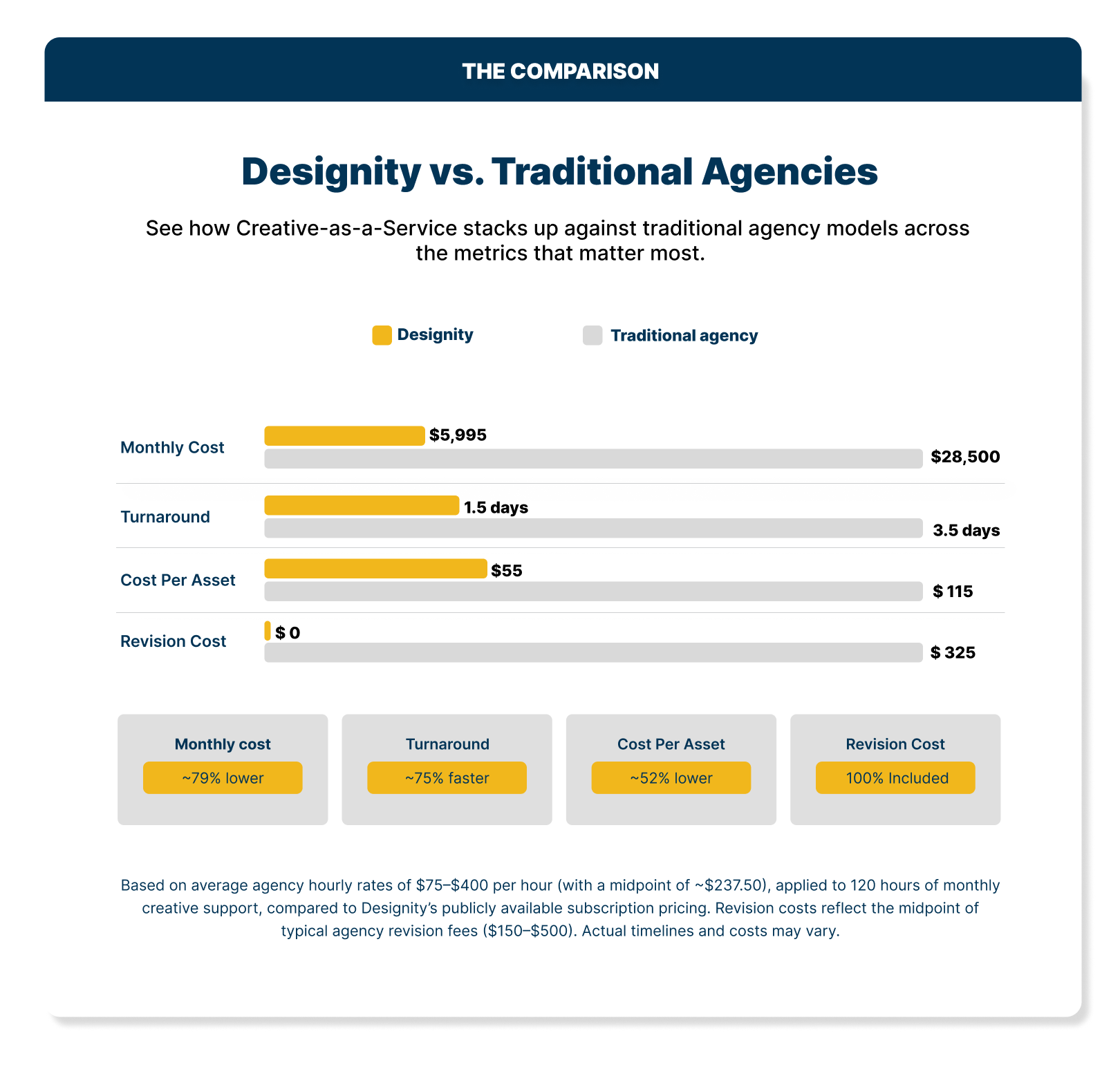
For example, Designity’s plans start at $5,995/month for 120 hours of creative support, which is equivalent to the output of a part-time-to-full-time creative resource.
Based on average agency rates of $75–$400+/hour (~$237.50/hour), this level of support could otherwise cost approximately $28,500/month through a traditional agency model.
Flexible month-to-month pricing and optional add-ons also make it easy to scale support up or down as workloads change.
Learn more about the ROI behind Designity’s flexible monthly pricing.
Subscription-Based Creative Services: Pros & Cons
Subscription-based creative services give you access to on-demand marketing professionals, without adding headcount or committing to hefty digital marketing agency retainers.
Pros:
- Predictable monthly spend without expanding headcount
- Access to specialized talent across design and marketing disciplines
- Expand internal team capacity with dedicated monthly creative hours
- Fixed monthly cost vs. variable hourly agency billing
- Scale support up or down based on campaign demand
- Faster turnaround on creative assets and campaign deliverables
- Centralized request, feedback, and revision workflows
- Consistent brand oversight across higher output
- Less time managing freelancers or internal production tasks
- Reduced recruiting, onboarding, and turnover risk
- Flexible month-to-month pricing vs. agency lock-ins
Cons:
- Not physically embedded in your office culture
- May not replace highly specialized, niche marketing experts
- Quality varies by provider, not all subscription models are equal
Hidden Costs of In-House Marketing and Agencies
The sticker price is rarely the final price. Whether you hire in-house or sign an agency retainer, there are always extras that quietly inflate your total spend.
Common In-House Hidden Costs:
- Benefits, taxes, and insurance (typically +25–40% per salary)
- Recruiting and onboarding expenses
- Ongoing training and professional development
- Marketing tech stack (CRM, automation, analytics tools)
- Turnover risk and rehiring costs
- Management time spent coordinating and reviewing work
Common Agency Hidden Costs:
- Setup and onboarding fees ($500–$5,000+)
- Software or platform subscriptions not included in retainers
- Limited revisions (extra rounds: ~$150–$500 each)
- Rush or priority turnaround fees (20–50%+)
- Reporting/dashboard add-ons ($200–$1,000+/month)
- Ad spend management fees (5–20% of media budget)
How Subscription-Based Creative Services Impact Marketing ROI
Below are some of the ways subscription-based creative services can improve campaign efficiency and performance:
1. Reallocate Budget Toward Growth Initiatives
A lean in-house marketing team can cost $375K+ annually in payroll alone.
After adding 25–40% for benefits, taxes, tools, and training, total annual costs can increase significantly, even when workloads fluctuate between launches.
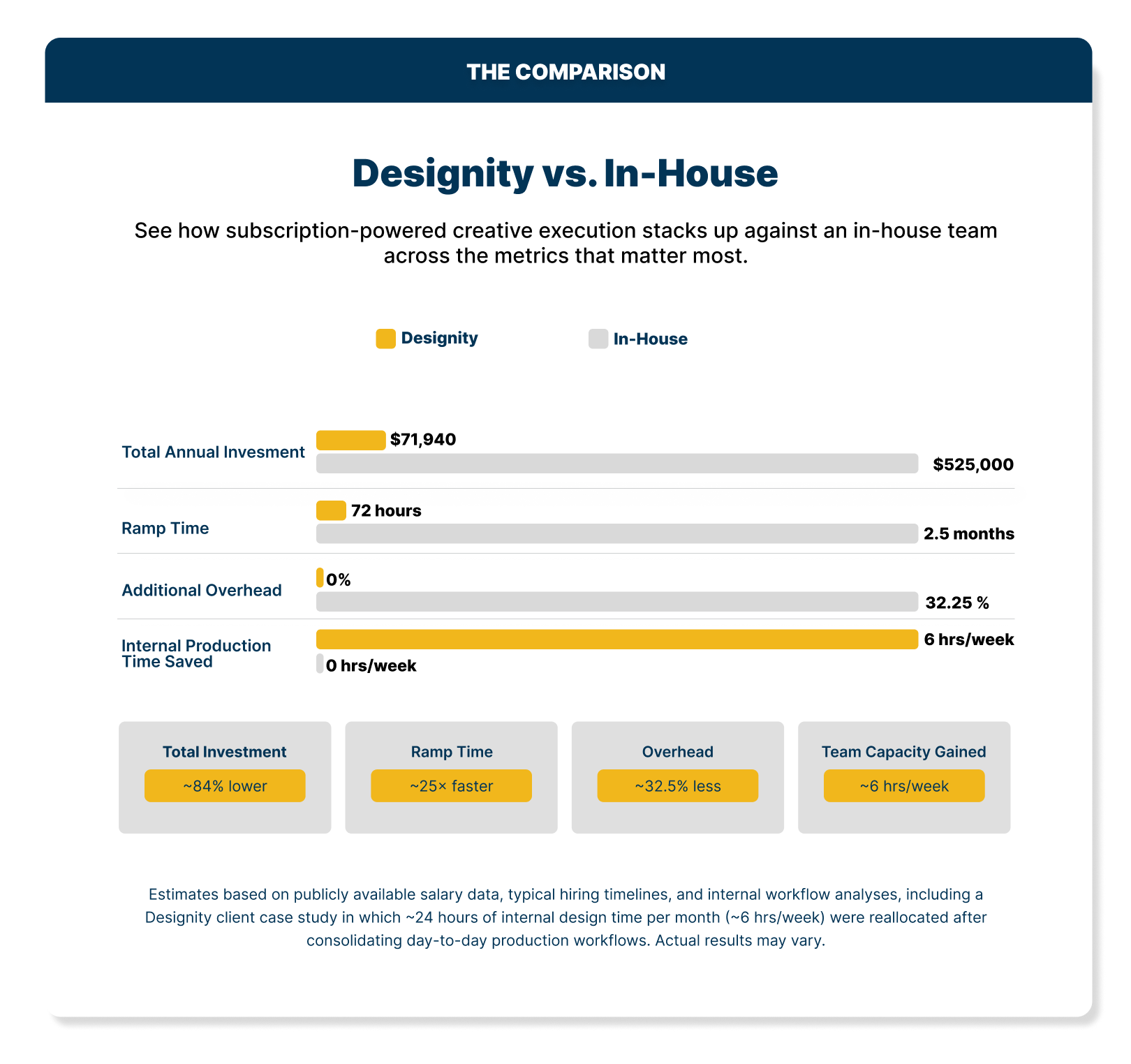
By comparison, Designity’s full-stack creative and marketing team starts at $5,995/month (~$71,940 annually).
This represents potential estimated savings of:
- $303K+ per year vs. payroll alone
- Additional savings when factoring in overhead costs
Savings from reduced salary commitments can be reinvested into media spend, campaign testing, or performance-driven initiatives without increasing total marketing spend.
2. Reduce Cost Per Campaign Asset at Scale
As campaign output increases, in-house teams may require additional hires, while agencies may charge for expanded scope, revisions, or faster turnaround.
Subscription-based services allow teams to execute more deliverables within a fixed monthly investment. Compared to traditional agency retainers, Designity’s Plus Plan delivers creative support at an estimated 52% lower cost per asset ($55 vs. $115).
This lower production cost can help teams scale campaign output more efficiently without increasing overall marketing spend.
3. Free Up Internal Time for Campaign Strategy
Coordinating creative execution across internal stakeholders, freelancers, or agency partners often requires significant time spent on onboarding, feedback loops, and project management.
In fact, marketers spend over 60% of their time on “work about work”, leaving less than 30% available for strategic or creative execution.
Based on internal workflow analyses and client delivery models, consolidating creative production can save internal teams an estimated 4–8 hours per week on simpler deliverables such as ad creative, social assets, or email design.
For more complex projects, such as landing pages or website design, time savings may increase to 8–15+ hours per week, depending on project scope and revision cycles.
In one Designity client case study, Right At School freed up approximately 24 hours of internal design time per month (or roughly 6 hours per week) after consolidating day-to-day production workflows.
This allowed their internal team to focus on campaign strategy and optimization.
4. Accelerate Time-to-Launch for Campaigns
Consistent access to monthly creative capacity allows teams to submit multiple campaign requests in parallel without waiting for hiring cycles or agency scope approvals.
Adaptable creative and marketing teams may deliver projects up to 40% faster.
With Designity, minor production tasks such as landing page updates or image swaps can often be completed within 24 business hours.
This helps teams accelerate time-to-launch for product launches, seasonal campaigns, and multi-channel initiatives.
5. Reduce Customer Acquisition Costs (CAC)
Customer Acquisition Costs have increased by as much as 60% over the past five years, with average CAC ranging from approximately $536 for B2B companies to $702+ for SaaS businesses.
Creative production costs such as salaries, onboarding, and agency fees are often included in the total cost of launching and optimizing campaigns.
By replacing these fixed or variable expenses with a predictable monthly investment in creative support, teams can reduce operational overhead tied to acquisition efforts.
This shift not only streamlines internal resourcing but also opens up more of the marketing budget to be allocated toward actual campaign delivery and media spend, rather than internal production costs.
As a result, lower production overhead may help reduce fully loaded acquisition costs over time, potentially lowering Customer Acquisition Costs (CAC) without relying on annual payment models.
{{two-week-trial}}
In-House Marketing vs Agency vs Subscription: When to Choose Each?
Cost and scalability aren’t the only deciding factors. The right model also depends on your internal capacity, campaign volume, and long-term marketing goals.
In-House Marketing Teams Are Best If You:
- Have consistent, year-round creative and marketing needs that justify the cost of full-time salaries and fixed overhead
- Want complete control over brand voice, internal processes, and day-to-day campaign execution
- Can afford to scale headcount when campaign demand increases, despite long hiring and onboarding cycles
- Need someone deeply embedded in your business for cross-functional collaboration and long-term strategy
- Are prepared to manage turnover risk, training, and capacity gaps when skill needs change
- Don’t mind paying for full-time roles even when specific expertise (like email marketing, UX or motion design) is only needed occasionally
Marketing Agencies Are Best If You:
- Have the budget for monthly retainers, onboarding fees, and potential change orders as scope evolves
- Prefer outsourcing execution to an external partner rather than managing internal production workflows
- Can commit to longer-term contracts (typically 3–12 months) to secure priority support
- Don’t mind rotating team members or sharing resources across multiple client accounts
- Are okay with scaling costs as campaign volume increases or turnaround timelines shorten
Subscription-Based Creative Services Are Best If You:
- Need ongoing creative and marketing execution, but don’t have the budget or consistent workload to justify full-time hires
- Want access to diverse skill sets like UX, branding, motion, paid ads, and web without committing to permanent salaries
- Prefer predictable monthly pricing that scales up or down with campaign demand
- Are launching campaigns faster than in-house hiring timelines or agency onboarding allows
- Have fluctuating creative and marketing needs that spike around product launches or seasonal initiatives
- Want to expand internal capacity without adding headcount or increasing payroll risk
- Need consistent brand execution across a growing volume of marketing and creative assets
- Value flexibility over long-term agency retainers or fixed internal team costs
Why Teams Are Choosing Creative-as-a-Service Platforms Like Designity
As creative demand increases, many marketing teams are finding that traditional in-house and agency models simply weren’t built to scale with today’s always-on content needs.
Creative-as-a-Service models offer a more flexible, cost-efficient alternative, giving you ongoing access to marketing and design expertise without the overhead of full-time hires or long-term agency retainers.
With Designity, you get:
- Plans starting at $5,995/month for a dedicated Creative Director and full-stack creative + marketing team
- Flexible monthly, quarterly, or annual pricing options
- Access to 100+ creative and marketing services on demand
- Unlimited requests and revisions for ongoing campaign support
- 2-week trial with no upfront payment
- Add-ons available to scale support as campaign needs grow
- The ability to pause or cancel anytime — no long-term lock-in
- Fully managed workflows, so you never have to juggle vendors or freelancers
- A dedicated CD as your single point of contact for clear communication and timelines
Book a demo call today and test-drive Designity’s 100+ creative and marketing services. No upfront payment.
FAQs
Here are the answers to a few questions related to in-house marketing, agencies, and Creative-as-a-Service models:
1. What If My In-House Marketing Team Lacks Bandwidth?
That’s exactly what Creative-as-a-Service platforms like Designity are built for.
They act as an on-demand extension of your internal team, helping you handle production-heavy tasks, campaign assets, and overflow work without hiring additional full-time staff.
2. Should I Hire an Agency or Use a Subscription-Based Creative Service for Ongoing Work?
For ongoing needs, subscription-based services often offer more flexibility than agency retainers.
Instead of locking into long-term contracts with fluctuating scopes, you get consistent monthly support that can scale up or down based on campaign demand.
3. What If My In-House Team Lacks Specialized Creative or Marketing Expertise?
Subscription-based services give you access to specialists across areas like branding, motion graphics, UX/UI, paid advertising, and more, without hiring separate full-time roles for each discipline.
4. Can a Subscription-Based Creative Service Support Urgent Projects?
Yes. With structured workflows and dedicated creative direction, subscription-based creative services like Designity can handle multiple requests in parallel, helping teams launch assets faster when timelines are tight.
5. How do Subscription-Based Services Maintain Consistent Quality?
Many platforms assign a dedicated Creative Director or Project Manager to oversee all projects, ensuring brand consistency and quality across assets, even as output volume increases.