









_2026-02-22_00-51-08.webp)
B2B social media marketing often gets treated like a content treadmill:
What should we post?
How often?
Should we be on every platform?
But those are execution questions, not strategy.
In reality, B2B buyers are making high-stakes decisions that affect budgets, teams, and sometimes their very own careers.
According to Forrester, 43% of B2B buyers make defensive purchase decisions most of the time, choosing the safest option to reduce risk.
That means your social presence isn’t just about visibility. It’s an early signal of competence, consistency, and dependability.
In this guide, we’ll walk through 10 steps to build a B2B social media marketing strategy that builds trust with decision-makers who aren’t impulse buying anything anytime soon.
What Makes B2B Social Media Marketing Different From B2C?
B2B social media marketing uses platforms like LinkedIn, Instagram, X, and YouTube to reach buyers and decision-makers, but the way people buy in B2B looks very different from B2C.
You’re not convincing someone to buy a candle because it matches their “Sunday reset” aesthetic.
You’re convincing an entire committee that your solution won’t get them side-eyed in the next budget meeting.
B2B decisions are usually:
- Made by multiple stakeholders: You’re convincing Marketing, Finance, IT, Legal, and whoever owns the budget. Social content should address different priorities across roles, from ROI to implementation risk.
- Driven by a higher need for trust: Choosing the wrong partner doesn’t just waste money. It can delay initiatives, impact team performance, and reflect poorly on the decision-maker internally.
- Focused on defensible expertise: Buyers aren’t looking for B2B companies that seem innovative. They’re looking for insights, benchmarks, or frameworks they can reference in internal discussions.
- Shaped by longer research cycles: Enterprise solutions are evaluated over weeks or months. Consistent educational content helps reinforce familiarity throughout that process.
- Harder to attribute directly: Social may not drive the final conversion, but it often influences perception before prospects ever speak to sales.
- Tied to internal accountability: Someone will eventually need to justify this investment in a planning meeting or quarterly review.
Which is why educational and thought-leadership content tends to outperform viral moments.
In B2B, social media isn’t about going viral. It’s about being helpful enough, often enough, that when it’s finally time to decide… your name comes up.
How to Build a B2B Social Media Marketing Strategy: 10 Key Steps
Here’s a step-by-step guide on how to build a successful B2B social media strategy:
1. Align Your Social Strategy with Business Goals
If social doesn’t support a business goal, it’s just noise.
Before you touch a social media content calendar, get brutally clear on why you’re posting. In B2B, social isn’t just “brand". It can actively support revenue when it’s tied to the funnel.
Pick the job your social strategy is hired to do, like:
- Build brand awareness (so you’re not a random logo when buyers start researching)
- Create demand (turn “who are you?” into “send me that report/webinar”)
- Support sales (answer objections before the first call even happens)
- Strengthen loyalty (keep customers confident they didn’t pick wrong)
For example: If your goal is pipeline support, you don’t post “We’re excited to announce…”
You post things that remove doubt:
- A “Here’s how implementation actually works” breakdown
- A quick demo solving one specific pain point
- A customer result with real context (timeline, constraints, outcome)
- A post that tackles a common objection head-on (“Yes, it integrates with ___”)
Result: Prospects show up to sales calls already educated, so your team can talk fit, not fundamentals.
2. Ground Your Content in Audience Behavior
Design, messaging, and content should reflect how B2B decisions are actually made by your target audiences, not how B2B brands want to sell.
Take ClickUp’s LinkedIn strategy. Their content moves beyond feature promotion to support buying committees evaluating tools over time.
They consistently share:
- AI agent demos in real workflows
- Product walkthroughs
- Customer-led use cases
- Implementation-style tutorials
- Problem–solution posts
- Event updates and third-party validation
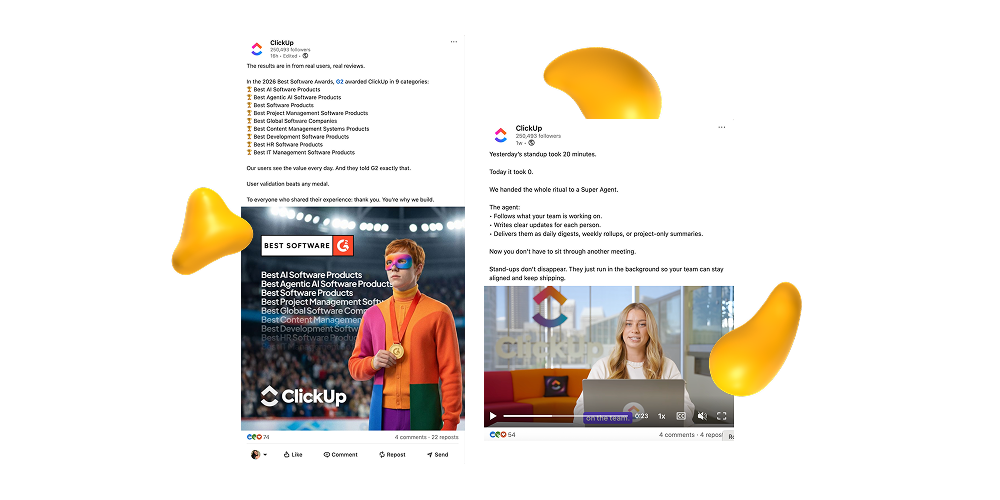
This aligns with how enterprise purchases happen. Stakeholders need to understand how a solution works in practice, and see proof that teams like theirs trust it.
The messaging shifts from “Here’s what our product does” to “Here’s how organizations like yours are already using it.”
3. Select Platforms Based on Strategic Fit
Platform selection is a strategic decision, not a trend to chase.
In B2B social media marketing, your goal isn’t to be visible everywhere. It’s to be credible where buyers go to research, compare, and validate vendors across longer decision cycles.
Ask:
Where do decision-makers evaluate solutions?
Where do teams share reports internally?
Where do buyers seek peer recommendations?
Focusing on the right platforms supports stronger messaging, more educational content, and consistent design, helping build trust throughout complex buying decisions.
4. Establish LinkedIn as Your Core Channel
For most B2B companies, LinkedIn should function as the foundation of your social media marketing strategy.
It’s where decision-makers actively research vendors, evaluate expertise, and share insights internally.
One American university study found that 75% of B2B buyers are influenced by information they find on social media, highlighting how critical these platforms are during vendor research.
LinkedIn supports longer-form storytelling, educational content, customer proof points, and thought leadership, helping buyers build internal confidence before recommending a solution during longer sales cycles.
5. Extend Reach Through Supporting Platforms
Supporting platforms like X and Instagram shouldn’t replace LinkedIn — they should reinforce it.
X can be used to share short-form insights, commentary on industry trends, and participate in conversations around launches, conferences, or news.
Why it works: X rewards clarity, timeliness, and consistency, helping maintain visibility between major content moments.
Design strategy note: While X is text-forward, consistent visual cues like branded graphics, typography, or simple templates help reinforce recognition and credibility without overproducing content.
On the other hand, Instagram can highlight behind-the-scenes moments, visually explain complex ideas, and showcase people, process, or partnerships.
Here's an example:
For Glytone, a professional-grade skincare brand offering both in-clinic peels and retail products for provider resale, Designity developed educational, clinically grounded Instagram content to support B2B marketing goals.
Led by Creative Director Matthew, the work included before-and-after treatment visuals, expert-led video discussions, and product explainer graphics, making technical skincare concepts easier to understand and easier for providers and partners to share with confidence.

Why it works: A thoughtful presence supports trust and human connection.
Design strategy note: Instagram is where design shines. Strong layouts can make educational content feel more approachable.
6. Develop a Clear and Cohesive Messaging Framework
In B2B social media marketing, consistency in messaging matters, but consistency doesn’t mean using identical language across every platform.
A strong framework defines:
- How you communicate value (business outcomes vs. product features)
- Which enterprise challenges you prioritize
- The terminology used across posts, campaigns, and thought leadership
- Your core differentiators (e.g., scalability, automation, compliance)
For example, IBM’s LinkedIn content consistently emphasizes enterprise outcomes like operational resilience, AI-driven efficiency, and hybrid cloud transformation, not just technical capabilities.
That same narrative may appear more simplified or visual on Instagram, but the underlying value proposition remains the same.
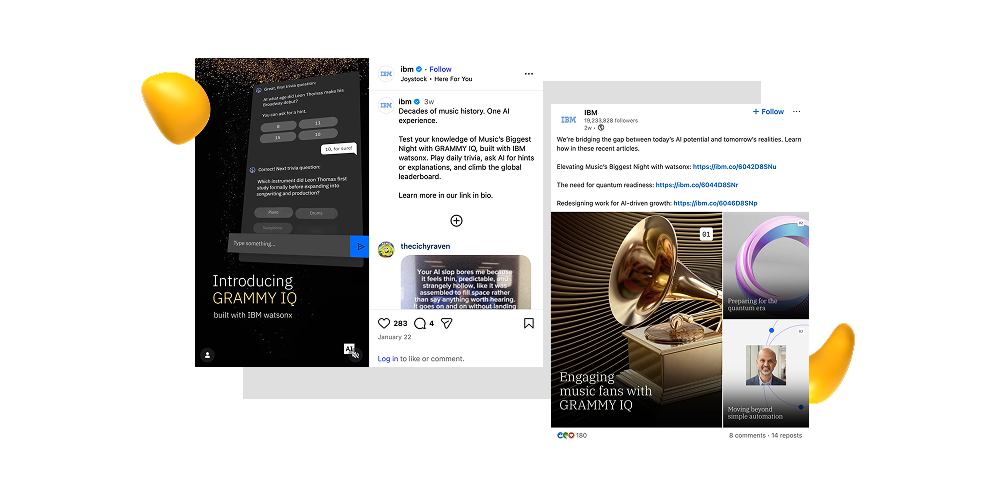
Over time, this creates a recognizable story across channels, helping buying committees understand what you do, how you’re different, and why your solution is worth defending internally.
7. Maintain Consistent Visuals and Brand Design
In B2B, inconsistency reads as risk. If your content looks different every week, buyers assume your implementation might too.
Establish design guidelines for:
- Typography and layout
- Color hierarchy
- Visual templates for carousels or videos
- Tone and illustration style
For example, for Thryv (a SaaS platform), Designity created a series of social ads delivering distinct campaign messages within a consistent visual system.
Also led by Creative Director Matthew, the work incorporated the brand’s orange palette, bold typography, grid backgrounds, and device mockups, ensuring each ad felt cohesive and instantly recognizable across platforms.
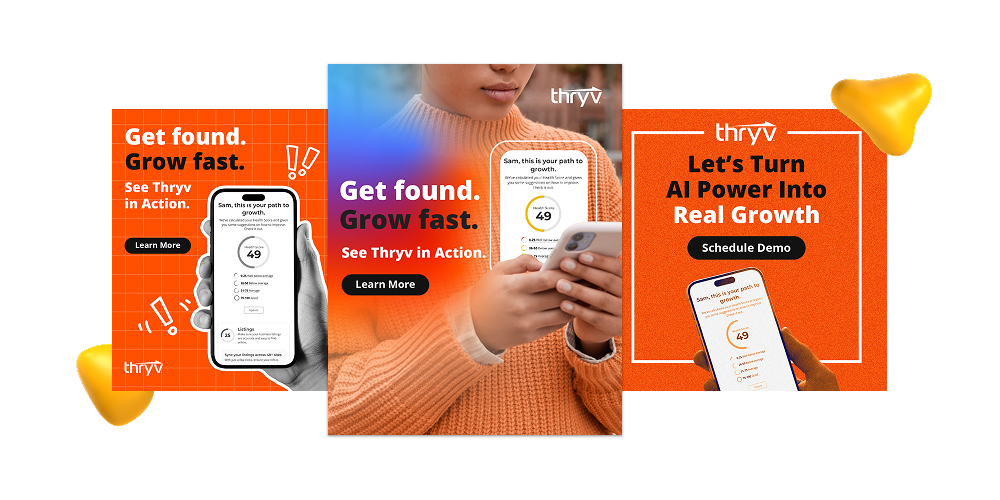
When social content feels polished and intentional, it signals operational maturity before a single sales conversation even begins.
8. Balance Organic and Paid Distribution Strategically
Organic builds trust. Paid helps more stakeholders see it before the budget meeting.
Organic social helps:
- Build credibility over time
- Educate buyers across longer sales cycles
- Keep your brand top of mind during research
Paid social helps:
- Reach decision-makers outside your network
- Support launches or campaign moments
- Reinforce key messaging through repeated exposure
For example, a B2B SaaS company might share an organic LinkedIn carousel explaining how to reduce onboarding time for new clients.
If that post receives strong engagement or saves, the brand can promote it through paid social to operations leaders or heads of customer success in target industries.
Instead of introducing a completely new offer, paid social extends the reach of content that’s already proven to be useful, helping more stakeholders encounter it throughout the research and evaluation process.
9. Measure Performance and Optimize Continuously
In B2B social media marketing, not all engagement is created equal, and not every marketing effort should be judged by reach alone.
Metrics like impressions, likes, comments, shares, follower growth, and video views can signal visibility, but they’re considered vanity metrics unless tied to downstream business outcomes.
To understand real impact, focus on metrics tied to buyer progression, like:
- Marketing Qualified Leads (MQLs): Prospects who engaged with social content and meet your ICP criteria
- Sales Qualified Leads (SQLs): Leads influenced by social who are ready for sales conversations
- Assisted Conversions: Deals where social played a role during the research phase
- Content Downloads or Demo Requests: Mid-funnel actions tied to intent
Use vanity metrics to optimize content, not to prove ROI. Tie performance back to pipeline influence wherever possible.
10. Maintain Consistency Over Time
Consistency is key to building trust in B2B social media marketing, but burnout helps no one.
You need a strategy your team can realistically sustain.
Showing up regularly with educational, insight-driven content helps reinforce credibility over time, keeping your brand familiar, dependable, and easier to advocate for throughout longer buying cycles.
{{drowning-in-projects}}
How B2B Social Media Marketing Builds Trust Before the Sales Call
In B2B, trust rarely comes from a single interaction. It’s built gradually, often long before a prospect fills out a form or speaks to sales.
Social media gives B2B brands a way to show up consistently throughout the decision-making process and demonstrate value early.
Over time, this helps reduce perceived risk and makes your brand feel more credible before formal evaluation even begins.
Here’s how that trust gets built in practice:
- Show expertise instead of telling people you have it: Anyone can claim to be innovative or industry-leading. Sharing insights, breaking down complex ideas, or explaining real challenges shows your audience how you think, without sounding like a pitch.
- Use social proof to reduce risk: Case studies, testimonials, client wins, and practical insights help buyers feel more confident in their decision and make your brand easier to advocate for internally.
- Consistency builds familiarity: Regular, intentional content makes your brand recognizable over time, so when it’s finally time to evaluate solutions, your business doesn’t feel new — it feels known.
3 Common B2B Social Media Marketing Mistakes to Avoid
Even with a strategy in place, a few common execution mistakes can quietly undermine your social media performance over time:
- Posting only promotional content: When the majority of your posts focus on product features, service offerings, or company announcements, your feed starts to function like an ad, not a resource. B2B buyers in research mode are looking for insights that help them understand a problem or evaluate a solution, not constant reminders that you exist.
- Inconsistent branding and messaging: Switching between visual styles, tones, or messaging pillars from post to post makes it harder for stakeholders to recognize and remember your brand. In B2B environments where trust is built gradually, this inconsistency can signal a lack of clarity or attention to detail.
- Treating social as an afterthought instead of a strategy: When posting depends on availability rather than intent, content tends to be reactive and disconnected from broader business goals. Without a defined purpose or content themes, social media becomes activity, not a channel that supports brand awareness or demand.
B2B Social Media Marketing Strategy Trends for 2026 and Beyond
B2B social media is shifting away from activity-driven posting toward more intentional strategy, and industry data reflects that change:
- Strategy Over “Just Posting”: According to the Content Marketing Institute’s (CMI) 2024 B2B Content Marketing Trends Report, social media is used by 90% of B2B marketers as a content distribution channel, making it the most popular way to share content online, which has pushed teams to align social efforts more closely with broader business goals rather than treating it as a standalone task.
- Built Around the Buyer Journey: 75% of B2B buyers use social media to research vendors, evaluate solutions, and support purchasing decisions, demonstrating its impact across awareness, consideration, and final selection stages throughout the entire B2B buying process.
- Being Focused Over Being Everywhere: A global survey found that 44% of B2B professionals rank LinkedIn as the most important social media platform, reinforcing the value of prioritizing the social channels that matter most.
- Content Planned Around Credibility: According to a study by market intelligence firm, IDC, 84% of C-level and VP-level decision-makers report being influenced by social media content when making purchasing decisions, increasing the need for consistent, expertise-led content.
- Organic and Paid Are Working Together: Sagefrog research shows that 43% of B2B teams leverage organic social, while 35% also run paid social ads, indicating a growing trend toward integrated distribution strategies.
- Success Is Being Measured More Thoughtfully: Metrics like impressions, likes, comments, shares, follower growth, and video views may reflect reach, but without connection to pipeline or revenue, they remain vanity metrics. Increasingly, stakeholders expect social performance to tie directly to business outcomes, with 65% of leaders wanting clear links between campaigns and goals (2025 Sprout Social Index).
Get Social. Get Strategic. Get Designity.
B2B social media marketing works when it’s treated as a strategy, not a side task.
With clear goals, the right channel mix, and content built around the buyer journey, social becomes a driver of trust, qualified traffic, and long-term demand.
But knowing the strategy isn’t the same as executing it.
Many teams struggle with limited bandwidth, inconsistent creative, or disconnected paid and organic efforts.
That’s where Designity comes in.
You get a dedicated Creative Director to lead strategy and execution, plus a vetted team of top-tier creative and marketing talent — all under one flat monthly plan and backed by 100+ creative and marketing services.
From organic social strategy and paid social campaigns to asset design, Google Display creative, and YouTube ad production, we handle the full ecosystem.
Book a demo and try Designity risk-free for two weeks, no upfront fee.