







.webp)
.webp)
Creative plays a huge role in marketing performance, but keeping up with the nonstop demand for content across channels is not easy.
For a lot of marketing teams, the usual options just are not cutting it anymore.
Agencies can be rigid, freelancers take time to manage, and in-house teams often don’t have the bandwidth or specialized skills to handle everything.
That is why more teams are turning to Creative as a Service (CaaS).
CaaS gives marketing and creative leaders on-demand access to specialized talent through a predictable, cost-effective subscription.
In this guide, we’ll look at why traditional creative models are falling short, when CaaS makes sense for teams, and the kind of ROI teams can unlock with a CaaS model like Designity’s.
What Is CaaS (Creative as a Service)?
CaaS is a subscription-based solution that connects marketing and creative leaders with on-demand marketing and design talent, making it easier to scale output without permanent hires.
Instead of hiring designers, finding freelancers, or throwing money at agencies, you can tap into the design and marketing expertise you need when you need it (without the overhead).
Think of it as a scalable creative engine.
Social media ads, motion graphics, branding, video, graphic design, landing pages, and more can be handled by top-tier talent, through a predictable monthly plan.
Why does that matter?
Marketing teams today face constant content demand, tight timelines, and a lack of skills and bandwidth in-house.
CaaS removes production bottlenecks, speeds up campaign execution, and lets your internal team focus on strategy, growth, and performance instead of managing creative work.
How Do Creative-as-a-Service Platforms Work?
In most cases, you’ll sign up with a CaaS platform for a set subscription fee (usually monthly).
Once you’re in, all you need to do is get the team up to date with your preferences, branding guidelines, and then start submitting your projects.
Based on what skills your project requires, the CaaS platform will source the appropriate creatives, fill them in with your requirements, and let them get to work.
Once your creative project is completed, your point of contact will send it to you for feedback.
Revisions are made until you’re happy with the result. Then later, rinse and repeat for as many projects as you need to complete.
8 Reasons Why Traditional Creative Models Aren’t Working Anymore
Marketing demand has exploded. More campaigns, more platforms, more formats. But traditional creative models were never designed to operate at this speed or scale.
Here’s where they start to break down:
- Creative demand is growing faster than internal bandwidth: Creative and marketing teams are being asked to produce more assets across more channels than ever before. Requests pile up, backlogs grow, and strategic work gets pushed aside as day-to-day execution consumes available capacity.
- In-house teams rarely have every skill needed on hand: Modern marketing requires a wide range of capabilities, from brand design and ad creative to motion graphics, UX, and campaign execution. Most internal teams are not staffed with every specialist they need, which creates gaps in expertise and slows production.
- Hiring full-time creatives is expensive and slow: A US graphic designer earns about $55,951 per year on average, and filling that role can easily take a month or more, often 4 to 8 weeks from opening the role to getting someone in seat. Add benefits, software, equipment, and overhead, and even a small in-house creative and marketing team can quickly become a six-figure investment.
- You don’t need every specialist full-time: While teams need access to specialized skills, they often don’t need each one 40 hours a week. Hiring full-time for every creative need leads to inefficiency, higher fixed costs, and underused talent.
- Scaling creative output quickly is difficult: Traditional creative models struggle when demand spikes. Product launches, campaign bursts, seasonal pushes, and high-volume testing can stretch teams beyond capacity, making it hard to ramp output up or down when needed.
- Agency retainers are costly, unpredictable, and rigid: Many marketing agencies operate on monthly retainers that can range from $25,000 to $500,000+ per month depending on scope and agency size. Even then, work is often limited by scope, approvals, timelines, and the realities of agency capacity.
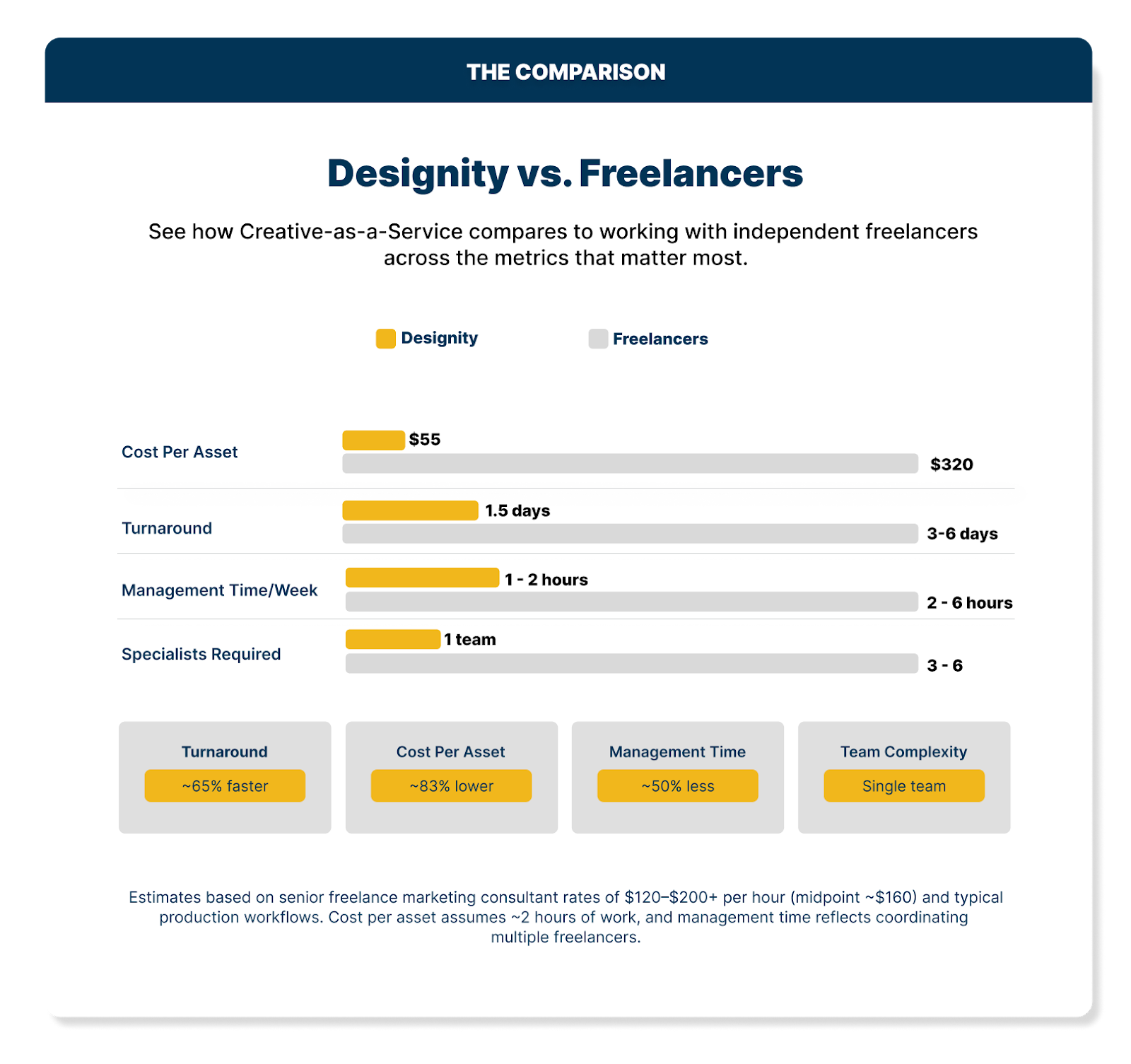
- Freelancers come with hidden operational costs: Finding freelancers is only the beginning. Teams still spend time onboarding them, managing timelines, reviewing revisions, coordinating feedback, and handling quality control across multiple contributors.
- Turnover creates disruption and slows momentum: When a creative leaves, progress slows, context is lost, and teams are forced back into a time-consuming hiring cycle. Even one open role can create production gaps, delay campaigns, and add pressure to the rest of the team.
When Creative as a Service Makes Sense for Marketing & Creative Leaders
CaaS is most valuable when marketing and creative leaders need to increase output, add specialized support, or move faster without expanding headcount.
Rather than replacing strategy, it gives teams flexible execution capacity where they need it most.
Here are some of the most common ways leaders leverage CaaS:
- To fill internal bandwidth gaps: When in-house teams are stretched thin, CaaS adds flexible creative capacity so campaigns, content, and design requests keep moving without overwhelming internal staff.
- To access specialized skills on demand: Modern marketing often requires support across design, motion, copy, digital, branding, UX, and more. CaaS gives teams access to the specific expertise they need, without hiring full-time specialists for every function.
- To scale output without adding headcount: For teams under pressure to do more with leaner resources, CaaS makes it possible to increase creative and marketing production without the cost, delay, and long-term commitment of expanding payroll.
- To keep campaigns moving faster: High-performing marketing teams rely on speed, especially when launching campaigns, producing content, or running ongoing tests. CaaS helps remove creative bottlenecks so execution can keep pace with demand.
- To stay agile as priorities shift: Creative needs rarely stay constant. CaaS gives teams the flexibility to scale support up or down as workloads change, without renegotiating agency scopes or rebuilding internal teams.
- To reduce the operational burden of freelancers and agencies: Managing multiple freelancers or navigating agency processes can slow teams down. CaaS simplifies execution by providing a more structured, centralized way to access creative support.
- To protect internal focus for higher-value work: When internal teams are stuck in day-to-day production, strategy, planning, and optimization often get pushed aside. CaaS helps offload execution work so leaders can focus on growth, performance, and long-term initiatives.
- To maintain momentum during hiring gaps or turnover: Open roles, delayed hires, and team changes can stall execution. CaaS provides immediate support that helps teams stay productive during periods of transition.
When Creative-as-a-Service May Not Be the Right Fit
CaaS works best for marketing and creative teams with ongoing needs, changing priorities, and enough work to benefit from a flexible creative team.
For some businesses, a simpler solution makes more sense:
- If you’re a solopreneur or very small team: If your creative needs are limited or occasional, you may not need an ongoing CaaS partnership. A freelancer or specialized provider can often give you the support you need without adding more capacity than you’ll actually use.
- If you only need help with a one-off project: Need a logo, a single landing page, or one specific deliverable? A project-based freelancer or agency may be a better fit. CaaS delivers the most value when there’s a steady pipeline of creative and marketing work rather than one isolated request.
Ultimately, CaaS makes the most sense when creative needs are ongoing and varied, and your team needs a flexible way to access the right expertise without continually hiring or managing multiple outside partners.
Now, let’s take a look at how CaaS compares to traditional creative models across the metrics that matter most to creative and marketing leaders.
Creative as a Service vs. Traditional Agencies
If you’re weighing CaaS against a traditional agency, the biggest differences usually come down to cost, speed, flexibility, and how much support you actually get for the price:

Creative as a Service vs. Freelancers
Freelancers can help fill short-term gaps, but this comparison shows how CaaS differs on delivery speed, quality control, management overhead, and scalability:
Creative as a Service vs. In-House Hiring
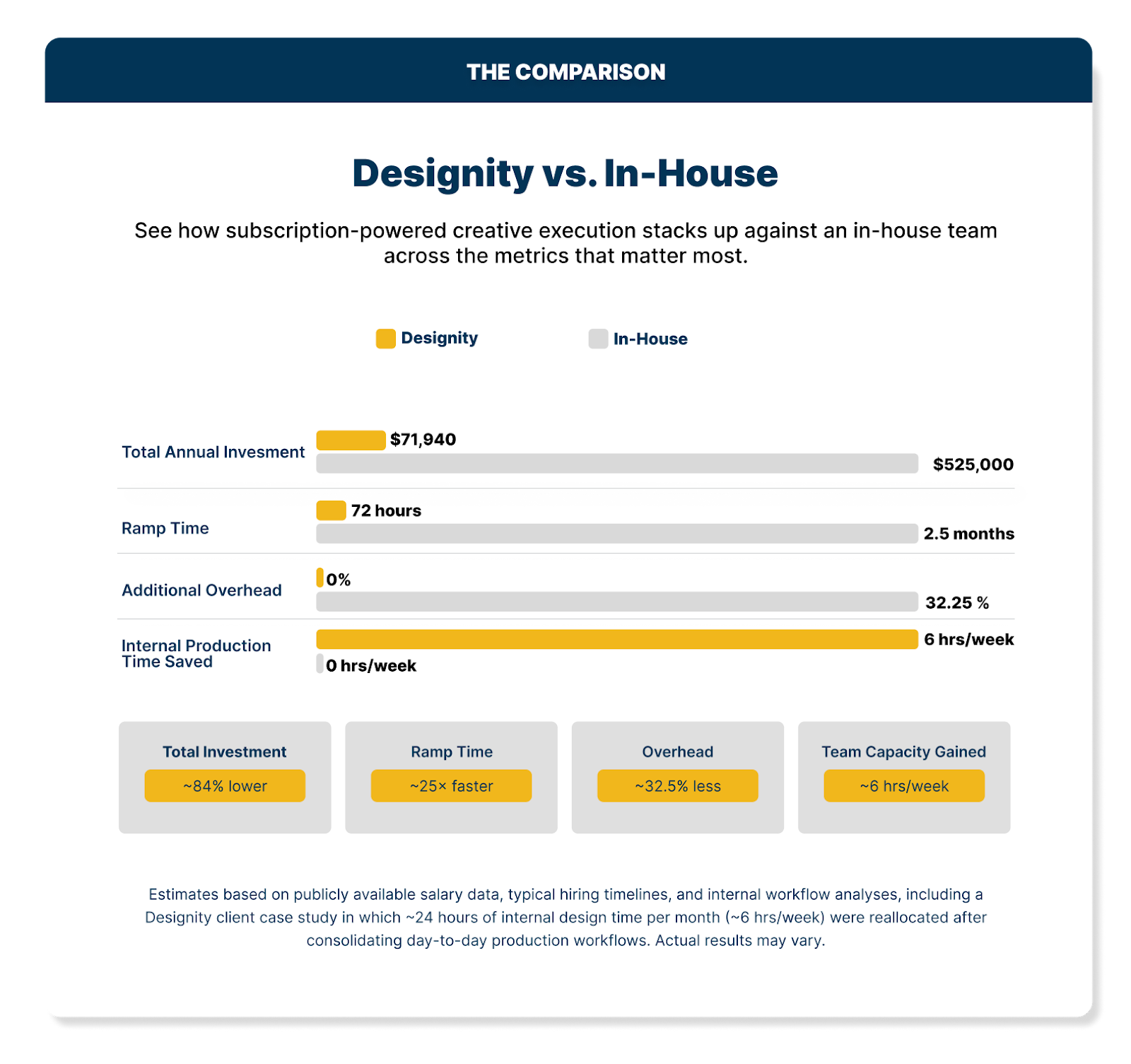
For teams deciding whether to hire or outsource, the key differences come down to long-term cost, ramp-up time, team flexibility, and how quickly you can access the skills you need:
Why Teams Choose Designity’s Creative-as-a-Service Model
Designity is a premium, AI-enabled and human-led Creative-as-a-Service (CaaS) platform that gives mid-market and early enterprise marketing teams the people, skills, and support they need to get great work done.
Instead of juggling freelancers, agencies, and an already-busy internal team, you get one flexible, managed creative team that can adapt to what you need and when you need it.
With Designity, you get:
- A dedicated Creative Director who gets to know your brand, leads strategy and creative direction, and makes sure the work meets the mark.
- A Creative Project Manager who keeps priorities, timelines, feedback, and delivery moving smoothly
- Top 1% global creatives and marketers selected based on the skills and expertise your projects need
- A fully managed workflow so your team spends less time coordinating people and projects
- Flexible creative capacity that can shift as campaigns, priorities, and needs change
- AI-enabled workflows that help teams move faster, while your Creative Director maintains context and quality across the work.
And if that’s not enough, here’s a closer look at how working with Designity can improve ROI across your marketing function:
1. Reallocate More Budget Toward Growth
Let’s start with cost.
A lean in-house marketing team can cost $375K+ annually in payroll alone, before benefits, tools, and training.
Traditional agency support can also add up quickly. Using the midpoint of common agency hourly rates, $237.50 per hour, 120 hours of monthly creative support would total about $28,500 per month, or $342,000 per year.
By comparison, Designity’s full-stack, Creative Director-led team starts at $5,995 per month, or about $71,940 per year for the same level of monthly support.
That creates potential savings of $303K+ annually versus payroll alone and about $270K annually versus a traditional agency benchmark, giving marketing leaders more room to invest in media, testing, and growth initiatives.
2. Keep Spend Predictable without Adding Headcount
Here’s where the model gets even more practical.
Instead of fluctuating project fees or taking on fixed payroll costs, Designity gives teams a predictable monthly spend for a full-stack creative and marketing team with the skills they need, when they need them.
That means no permanent headcount to manage, no annual salaries to absorb, and no long-term hiring commitments just to keep campaigns moving.
For marketing leaders, it creates better cost control, fewer budget surprises, and a more flexible way to scale creative support as priorities shift.
3. Free Up Internal Time for Strategic Work
And now for the hidden (yet most important) ROI: time.
Marketers spend over 60% of their time on “work about work,” leaving less than 30% for strategy and execution.
By consolidating production, Designity can save teams an estimated 4–8 hours per week on simpler deliverables and 8–15+ hours on more complex projects, freeing leaders to focus on growth.
4. Launch Campaigns Up to 40% Faster
Speed matters, especially when campaigns, launches, and testing cycles are moving fast.
Designity gives teams ongoing creative capacity without hiring delays or agency slowdowns.
Our adaptable dedicated teams can deliver projects up to 40% faster, and smaller tasks like image swaps or landing page updates can often be completed within 24 business hours.
That means faster launches and fewer bottlenecks.
5. Expand Capacity and Skillset without Hiring
For marketing and creative leaders, this is a big one.
Designity helps teams increase output without hiring more full-time staff.
With a dedicated Creative Director, dedicated digital marketing expert, and access to specialized talent, teams get the support they need to handle more work, protect internal bandwidth, and maintain quality without expanding payroll.
6. Reduce Operational Overhead That Impacts CAC
Customer acquisition costs have risen by as much as 60% in the past five years, and creative production costs are part of that equation.
Salaries, onboarding, agency fees, and internal coordination all increase the cost of launching campaigns.
Designity replaces much of that overhead with a predictable monthly investment, helping teams improve efficiency and protect acquisition economics over time.
7. Maintain Brand Consistency at Scale
More output usually creates more opportunities for inconsistency.
Designity helps teams scale creative production without sacrificing brand quality.
With dedicated creative leadership and managed execution, teams can produce more assets across more channels while keeping messaging, visuals, and standards aligned.
That means less rework, fewer off-brand deliverables, and stronger consistency as volume grows.
In fact, teams working with Designity often see 60% fewer revisions thanks to our Creative Directors, Project Managers, and AI-enhanced workflows.
8. Bring Order to Creative Collaboration
Let’s be honest: scattered workflows slow everything down.
When requests, feedback, revisions, and approvals live across emails, Slack threads, and documents, projects get harder to manage and easier to delay.
Designity brings that work into one managed workflow with clear ownership, centralized communication, and better visibility, so teams spend less time chasing updates and more time moving work forward.
9. Create a More Flexible Resourcing Model
Marketing demand is never static. Some months require heavy production, while others shift priorities fast.
Designity gives teams a more adaptable and scalable model with monthly, quarterly, and annual plans, plus the ability to pause or cancel anytime.
With access to 100+ scalable creative services, unlimited requests and revisions, and instant add-ons, teams can scale support without long-term lock-in.
"We have been working with Designity for a short time now and the biggest value of Designity is being able to work with a creative director to execute projects. The most exciting part about this collaboration is knowing that we are able to express our needs with the creative director to make our projects a reality."
Make the Switch to Designity's CaaS Today
If your marketing or creative team has ongoing work, changing priorities, and a growing need for specialized skills, CaaS can give you a more flexible way to expand your capabilities.
Designity brings together:
- A dedicated Creative Director who leads strategy and creative quality
- A Creative Project Manager who coordinates workflow and delivery
- Top 1% global creatives and marketers selected around your project needs
- Flexible access to creative and marketing capabilities as priorities change
- Fully managed workflows that reduce the coordination burden on your team
- AI-enabled processes that support greater efficiency while keeping strategy, judgment, accuracy, and final quality human-led
For mid-market and early-enterprise marketing teams, that means you can add capacity and capabilities while keeping the model flexible as your needs evolve.
Ready to see how it could work for your team?
Book a demo to explore Designity’s AI-enabled, human-ed Creative-as-a-Service platform.
5 FAQs Related to Creative-as-a-Service
Here are the answers to a few remaining questions you may have:
1. Is CaaS only useful for high-volume creative work?
Not necessarily. Volume matters, but so do variety and coordination. CaaS can be useful when a team has recurring work across campaigns and channels, even when the work does not arrive in a neat, predictable queue.
2. Does CaaS replace an in-house marketing or creative team?
No. It can extend an in-house team or help cover gaps, but internal leaders still own business priorities, approvals, subject-matter accuracy, and final decisions.
3. What is a practical CaaS use case?
A product launch that needs coordinated creative across several channels is a common example. Other use cases include adapting approved campaign concepts, bringing in a specialist for a recurring need, and keeping work moving while a team hires.
4. How should a marketing team assess CaaS ROI?
Compare equivalent work, not just a monthly fee or asset count. Include internal coordination time, specialist needs, approval flow, rework, and what happens when campaign priorities shift.
5. Can CaaS work alongside freelancers or an agency?
Yes, when responsibilities are clear. A CaaS partner can support ongoing campaign work while a freelancer handles a focused need or an agency leads a defined strategic project. The important part is deciding who owns each handoff.