





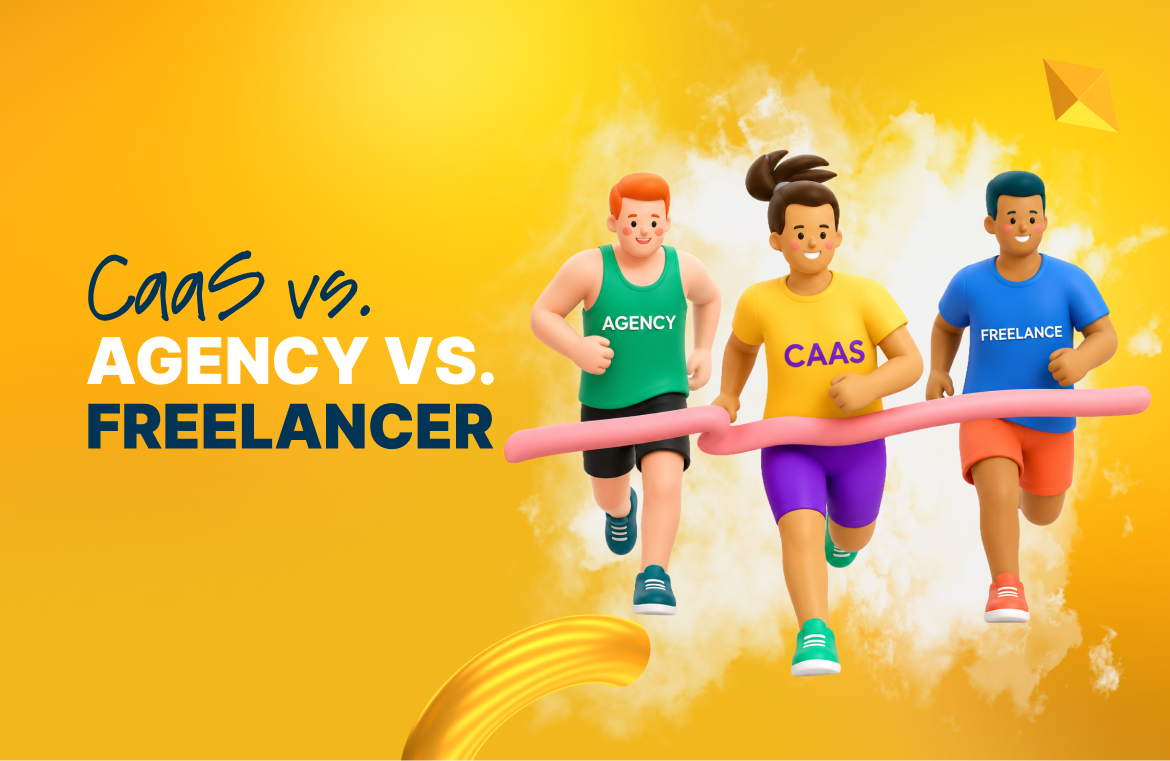
Freelancer, agency, Creative-as-a-Service. Three ways to get great creative work done. Three very different ways to manage it.
A freelancer can crush a focused brief.
An agency can bring serious firepower to a major initiative.
Creative-as-a-Service can keep ongoing, changing work moving without making your marketing team play creative traffic controller.
So, which should you choose?
Start with ownership.
Who will lead the strategy, find the right specialists, manage the workflow, and protect quality?
Answer that, and the Creative-as-a-Service vs. agency vs. freelancer decision gets a whole lot easier.
Creative-as-a-Service vs. Agency vs. Freelancer: What's the Difference?
The biggest difference comes down to how much of the creative operation your team needs to own.
Here’s what we mean:
- A freelancer typically provides a specific skill or service. Your team usually owns the brief, direction, coordination, and final approval. And don’t get us wrong, that can be a lot of plates to keep spinning on your side even if the freelancer rate looks cost effective.
- An agency typically brings a team together around a defined engagement, such as a campaign, launch, or rebrand. Great when there’s a clear finish line, but less flexible when priorities start doing what priorities do.
- Creative-as-a-Service (CaaS) is an ongoing, on-demand model that can combine creative strategy, specialist talent, execution, and management as priorities change. So when the brief changes on Tuesday, you’re not rebuilding your creative setup by Wednesday.
Providers within every category vary, so treat these as starting points rather than universal rules.
How to Choose Between Creative-as-a-Service, an Agency, and a Freelancer
Before comparing rates, portfolios, or impressive-looking proposal decks, figure out who needs to own four things:
1. Who Owns Creative Strategy and Direction?
Someone has to translate the business goal, audience, and brand into a clear creative direction.
Who writes the brief?
Who knows when a request needs a fresh concept instead of version 27B?
Who makes the creative call when opinions collide?
If you already have strong creative leadership internally, you may only need specialist execution.
If you don't, adding more hands can create more work to direct.
2. Who Finds and Manages Creative Specialists?
Today's campaign might need a graphic designer. Tomorrow’s campaign might need web developers or a digital marketing expert with strong expertise in social media management.
For a contained project, finding one specialist can be simple.
When the work keeps changing, sourcing and coordinating the right skill sets can become a full-time job of its own.
Ask whether your internal team wants to own that job or whether your creative partner should.
3. Who Manages Creative Workflow and Feedback?
Creative work comes with briefs, priorities, timelines, stakeholder feedback, approvals, handoffs, and the occasional comment that somehow contradicts the comment directly above it.
Someone has to turn all of that into a useful next step.
Before choosing a partner, ask who will organize priorities, resolve conflicting feedback, and keep work moving.
If the answer is always your marketing team, factor that management time into the decision.
4. Who Protects Creative Quality and Brand Consistency?
A polished asset can still be the wrong asset.
Quality means keeping the work connected to the audience, objective, brand, and broader campaign. That becomes harder as more specialists, channels, and stakeholders enter the picture.
The more creative work you're producing, the more important clear quality ownership becomes.
Creative Partner Ownership Comparison
Before signing anything, map where each responsibility will live:
No partner removes the need for client context, feedback, or final business decisions.
So, the question is:
How much creative leadership and management you want them to carry along the way.
When to Choose a Freelancer, Creative Agency, or Creative-as-a-Service
Use this breakdown to decide which creative model fits your workload, budget, and how much your team wants to manage internally:
Freelancers Are Best If You:
- Need one specific skill for a clearly defined project
- Have a strong brief, scope, and deadline
- Can manage creative direction, feedback, and approvals internally
- Don’t need several disciplines working together
- Want flexible support or project based pricing without a larger commitment
Freelancers can be a great fit for focused work.
The challenge starts when one freelancer turns into five, and your team is suddenly sourcing, briefing, coordinating, reviewing, and keeping everyone aligned.
That can still work. Just remember that management time is part of the cost, even when it doesn’t show up on the invoice.
"Love Designity and their organization! Very happy with their process and quality. Before Designity I've tried many solutions from 99Designs to Upwork and most of the time I had to chase my designers and deal with a lot of back and forth to get the job done. Nice to see Designity has resolved these issues."
Creative Agencies Are Best If You:
- Are planning a major campaign, launch, or rebrand
- Have a clearly scoped initiative
- Want an outside team focused on one strategic project
- Have budget for retainers, onboarding, and possible change orders
- Can commit to a longer engagement, often 3–12 months
- Can support briefing, reviews, and stakeholder approvals
Traditional agencies can bring strategy, specialist talent, and a valuable outside perspective to big brand moments.
The tradeoff is that they can come with longer onboarding, fixed retainers, slower turnaround, shared resources, and extra fees when scope or priorities change.
Creative-as-a-Service Is Best If You:
- Have ongoing creative and marketing demand
- Need support across multiple channels, formats, or campaigns
- Regularly need different specialists
- Want more capacity without managing more vendors
- Need fast turnaround times and brand consistency as output grows
- Want strategy, execution, workflow, and quality control connected
- Need flexible support that can shift with your marketing efforts and priorities
Creative-as-a-Service is built for teams whose creative needs keep moving.
The leadership layer matters here.
A monthly service that only takes requests and returns assets is closer to a production subscription.
A premium CaaS model should also bring creative direction, specialist matching, workflow support, and quality control.
Explore how Creative-as-a-Service costs compare to agencies, freelancers, and in-house teams.
When Freelancers Stop Being the Simple Option: Smokeball Case Study
Smokeball’s Designity case study shows how that shift can happen.
The team had used a freelance marketplace, but as creative needs expanded, so did the coordination required to manage the work.
With Designity, Smokeball worked with a dedicated Creative Director and specialist creatives, giving the team a more managed way to support ongoing creative work.
The takeaway: freelancers can be brilliant for the right scope.
But when sourcing, briefing, coordinating, and reviewing individual contributors becomes a recurring burden, a model with creative leadership and management built in may make more sense.
Learn more about why Smokeball switched to Designity’s AI-enabled, human-led CaaS platform.
Can You Use Creative-as-a-Service, Agencies, and Freelancers Together?
Absolutely. Many marketing organizations use a hybrid creative model.
You might hire an agency for a major rebrand, bring in a specialist freelancer for a niche assignment, and use an ongoing creative partner to support the stream of work around them.
The important part is clear ownership.
Decide:
- Who owns the overall creative direction?
- Who maintains the brand context?
- Which work goes to which partner?
- Who coordinates overlapping projects?
- Who resolves conflicting feedback?
- What happens when priorities change?
Multiple partners aren't automatically a problem, but vague ownership is.
Creative-as-a-Service vs. Agency vs. Freelancer: Pros and Best-Fit Use Cases
Use this table to compare where each creative model fits best, what it’s strongest at, and what your team still needs to manage internally:
Creative-as-a-Service vs Agency vs Freelancer: Cost Comparison
The cheapest-looking option isn’t always the most cost effective.
Annoying, but true.
A lower hourly rate can still come with more sourcing, briefing, feedback, and project management on your side.
These ranges are only a starting point. The real cost depends on the scope, output volume, specialist coverage, turnaround needs, and how much management your team still owns.
That’s why there’s no universal winner in the Creative-as-a-Service vs. agency vs. freelancer cost debate.
The better question is which model gives your team the right mix of quality, flexibility, creative leadership, and support for the work you actually need done.
How Designity's Creative-as-a-Service Model Works
Designity is an AI-enabled, human-led Creative-as-a-Service (CaaS) platform for established marketing teams that need ongoing creative and marketing support without building larger in-house teams.
Instead of juggling freelancers, agencies, and specialist vendors, Designity gives you one fully managed Creative Director-led team that can flex around your workload, brand, and changing priorities.
With Designity, you get:
- A dedicated Creative Director to lead strategy, specialist matching, and creative quality
- Creative Project Management to keep priorities, timelines, feedback, and delivery organized
- Access to top 1% creatives and marketers matched to each project
- AI-enabled workflows with human judgment, taste, and oversight
- Flexible support that can shift as campaigns, channels, and priorities change
- A 2-week trial with no upfront payment so you can test our CaaS platform before committing
Designity Is Best For:
- Mid-market and enterprise teams with ongoing creative and marketing demand
- Teams that need more capacity without managing more freelancers, agencies, or vendors
- Brands that need stronger creative leadership, quality control, and consistency
- Companies with changing priorities across campaigns, content, design, web, and video
Designity May Not Be For:
- Early-stage startups, solo entrepreneurs, or teams with occasional creative needs
- Teams only looking for one-off tasks or low-cost production support
Designity: Premium Creative-as-a-Service for Teams Ready to Scale
When comparing Creative-as-a-Service vs agency vs freelancer, the right choice comes down to ownership.
Freelancers work well for focused tasks.
Agencies offer support for defined, high-stakes initiatives.
But when your creative needs are ongoing, multi-channel, and constantly shifting, Designity gives you a more flexible option: a fully managed creative and marketing team led by a dedicated Creative Director.
Book a demo to see how Designity can support your current workload during a 2-week trial with no upfront payment.
4 FAQs Related to Creative-as-a-Service vs. Agency vs. Freelancer
Here are the answers to a few more questions you may have:
1. Is a Freelancer Cheaper Than an Agency or Creative-as-a-Service?
It depends on the work.
Compare the provider cost alongside the internal time required for strategy, briefing, sourcing, coordination, feedback, and quality control.
A lower visible rate can still require more management from your team.
2. What's the Difference Between Creative-as-a-Service and a Creative Agency?
Creative agencies are usually built around scoped campaigns, launches, or rebrands, often with monthly retainers, onboarding fees, change orders, and 3–12 month commitments.
Creative-as-a-Service is built for ongoing support, with flexible creative capacity, specialist access, and workflow support that can adapt as priorities change.
The real difference is how much strategy, management, and long-term commitment your team wants to own.
3. When Should I Hire a Freelancer Instead of an Agency?
A freelancer can be a strong choice when you need a specific skill for a contained project and have the internal expertise to direct and review the work.
If the project requires multiple disciplines, significant coordination, or outside strategic leadership, an agency or managed, full-service creative partner may be a better fit.
4. Is Creative-as-a-Service an Alternative to a Creative Agency?
It can be.
Creative-as-a-Service is one way to access ongoing creative strategy and execution without relying exclusively on project-based agency engagements or individually managed freelancers.
The better option depends on your workload, internal capabilities, specialist needs, budget, and desired level of management.