



.webp)
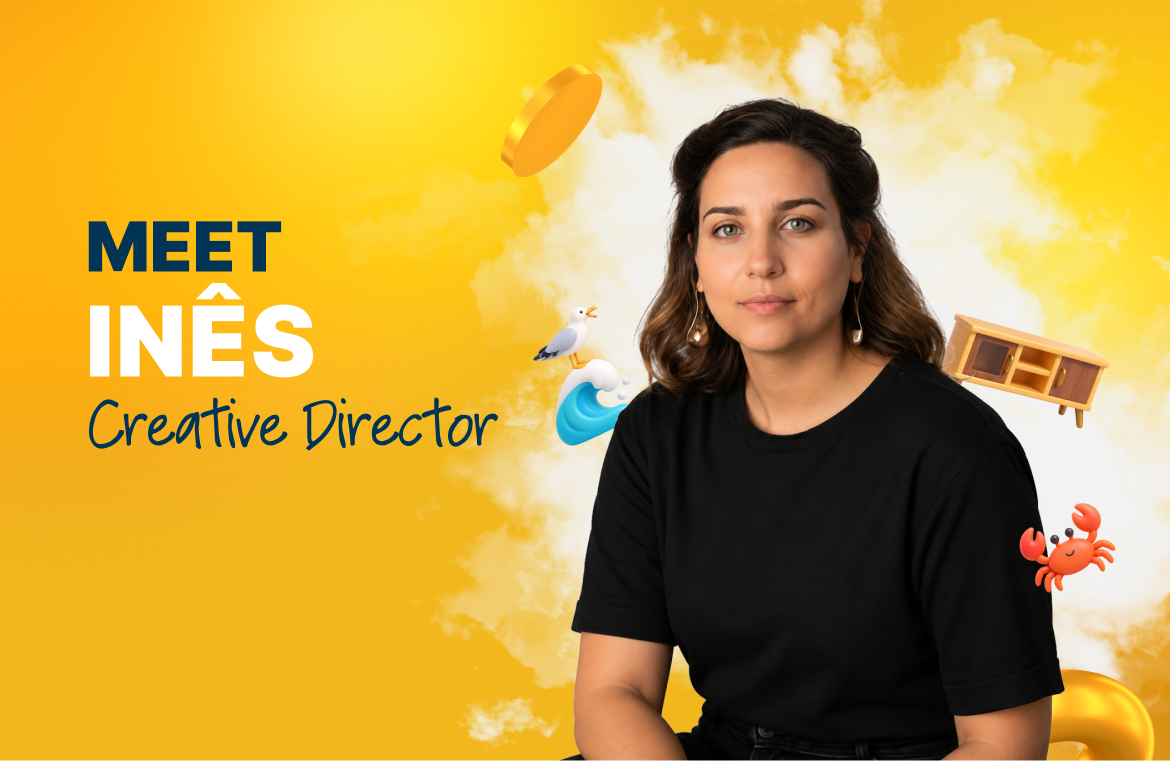
At Designity, we love spotlighting the people behind the ideas.
And for Creative Director Inês Félix, every good idea starts with a pretty important question:
What will make people care?
With 12+ years in the creative industry, Inês has worked with brands like KFC, Samsung, MasterClass, and Wikipedia and earned more than 20 awards across campaigns and platforms.
Along the way, she’s become especially interested in what separates creative that simply looks good from creative that actually sticks with you.
Her approach combines brand strategy, sharp creative thinking, human judgment, and a growing toolkit of AI-powered possibilities.
But tools are only tools. The idea still has to earn its place.
Here’s how Inês thinks about creativity, leadership, AI, and the work worth making.
Start With the Idea, Then Make It Beautiful
Before the visuals, typography, animation, or AI-generated anything, Inês starts somewhere simpler: Why should anyone care?
1. You often ask, “What will make people care?” How does that shape your creative process?
It’s usually my first filter. Before thinking about what something should look like, I want to know why anyone would stop for it in the first place.
We’re asking people for their attention all day, every day, so “it looks nice” isn’t really enough.
I try to find the tension, insight, or little human truth that gives the idea a reason to exist.
Then we can make it beautiful.
But first, make me care.
2. You studied Graphic Design and Advertising, then earned a Master’s in Branding and Packaging. How has that shaped your approach to brands today?
I think it taught me to look at brands from different distances.
Graphic design taught me craft. Advertising taught me ideas. Branding taught me systems and consistency.
And packaging taught me something I still think about a lot: you often have very little space and very little time to communicate a lot.
Today, I naturally move between those levels.
I can obsess over a tiny visual detail and five minutes later zoom out and ask, “Okay, but does this actually make sense for the brand?”
Both matter.
Protect the Idea, Not Your Ego
More than a decade into her career, Inês’ definition of creative leadership has changed.
Less having all the answers.
More asking better questions, creating clarity, and giving talented people enough room to surprise you.
3. With 12+ years in the creative industry, how has your approach to creative direction evolved?
Earlier in my career, I probably thought being good creatively meant having the answer.
Now I think being a good Creative Director is much more about asking the right questions.
My job isn't to make everyone execute my idea. It's to create enough clarity and direction that talented people can bring something to the table that I might never have thought of myself.
And I genuinely love when someone comes back with something better than what I had in mind.
That's the point.
I've also become much less attached to execution and much more protective of the idea.
The execution can change 20 times.
If the idea is right, we have something.
4. How do you tell a strong idea from one that’s simply well-executed?
I mentally take the design away.
If I describe the idea in one sentence and it’s still interesting, there’s probably something there.
If it only becomes interesting once I show you the beautiful typography, animation, photography, or AI visual… we may just have a very pretty execution.
I love craft, obviously.
But craft should make an idea stronger, not disguise the absence of one.
5. You’ve worked with brands like KFC, Samsung, MasterClass, and Wikipedia. What have those experiences taught you about creating work that connects?
Working with such different brands taught me that there’s no formula for connection.
What works for KFC would make absolutely no sense for Wikipedia, and that’s the point.
You have to understand what makes each brand itself: its audience, its culture, its voice, and the space it has permission to play in.
Then you find the human truth that connects the brand to the people you’re trying to reach.
I think that experience made me much less interested in following trends or repeating what worked before.
The idea has to feel right for that brand, not just like a good idea that could belong to anyone.
6. You’ve won 20+ awards across campaigns and platforms. What do you think separates memorable creative from work that simply looks good?
The work I remember usually has something I wish I'd thought of.
It might be ridiculously simple, funny, uncomfortable, emotional, or just incredibly smart, but there’s a thought behind it.
Beautiful work can make me stop for a second.
A great idea makes me stop, understand it, and then annoyingly think about it again later.
That's the difference I'm always chasing.
More AI Means More Need for Human Taste
AI can give creative teams more directions, more variations, and more possibilities than ever before.
Which sounds great.
Until you’re staring at direction #100 and someone still has to decide whether any of them are actually good.
7. When AI gives us more creative options, what role does human taste play in choosing what’s worth pursuing?
Probably a bigger role than ever.
AI has made generating things incredibly easy.
Generating good things is still hard.
If I can make 100 directions before lunch, the valuable skill isn't producing direction 101.
It's knowing that #37 has something, #52 looks impressive but says absolutely nothing, and #81 is weird enough that maybe we should push it.
Taste, judgment, context, instinct: those become more valuable when options become almost infinite.
8. What does a healthy human-led AI workflow look like, and where should Creative Directors stay in control?
I want AI everywhere it makes us faster, more curious, or able to explore something we couldn't explore before.
I don't want it making the decisions.
For me, a healthy workflow is very human at the beginning and very human at the end.
We define the problem, insight, strategy, and creative ambition.
AI can help us explode the middle: explore, prototype, challenge, visualize, iterate.
Then humans come back in with taste and judgment:
"What actually deserves to exist?"
The CD needs to stay responsible for the why.
AI can give me fifty ways to make something.
It can't decide which one is right for the brand, audience, and moment.
When Deliverables Turn Into an Idea
One of the things Inês enjoys most about Designity is the variety.
Different industries. Different problems. Different creative muscles.
And sometimes, a brief that starts as a list of deliverables suddenly clicks into something much bigger.
9. Is there a Designity project that’s stretched your thinking or reminded you why you love creative direction?
What I've really enjoyed at Designity is the variety.
I can go from healthcare to finance to SaaS to something completely different in the same day, and every problem asks you to reset your brain.
Some of my favorite projects have been the ones where the brief initially sounds very functional: “We need some ads, we need a landing page, we need a campaign.” Then you find the thought that suddenly connects all of it.
That's the moment I love.
When it stops being a collection of deliverables and starts becoming an idea.
10. What does a Creative Director bring to AI-enabled workflows that technology alone can’t?
A point of view.
AI can generate. It can remix. It can help us explore faster than we've ever been able to.
But someone still has to say:
"This one. Not that one. Push this. Kill that. This feels like us. This doesn't."
And sometimes:
"Technically this is perfect, but I hate it."
That judgment is incredibly human.
Creative direction has never really been about making the most things.
It's about knowing which things are worth making.
Power Tools, Ocean Time & What Comes Next
Creative problem-solving doesn’t always happen behind a screen.
Sometimes it involves furniture, questionable DIY confidence, or deliberately trying not to think about work at all.
11. Do furniture flips, DIY projects, or time by the ocean influence how you approach creative problems?
For me, creativity is problem-solving.
Sometimes I solve it with a computer, sometimes with AI, and sometimes with my hands and a slightly questionable amount of DIY confidence.
That’s why I love furniture flips and DIY projects.
They’re just another canvas.
I see something and immediately think:
"What could this become? How could I make it better? What if I tried this instead?"
It’s the same curiosity I bring to creative work, just without a client brief — and usually with more power tools.
And the ocean is probably the opposite.
That’s where I try very hard not to solve anything.
Which, annoyingly, is often when the ideas show up.
12. What are you most excited to explore or get ridiculously good at next, creatively or with AI?
I want to get ridiculously good at making AI feel less like AI.
Not necessarily visually but conceptually.
I'm interested in what happens when these tools become so integrated into the creative process that we stop talking about the tool and start talking about what we made with it.
Anyone can generate an impressive image now.
That's already becoming ordinary.
I'm much more interested in using AI to build ideas, experiences, stories, and workflows that we genuinely couldn't have made before.
The exciting question for me isn't:
“What can AI make?”
It's:
“What can we imagine now that wasn’t possible before?”
Create Your Best Work at Designity
Great creative needs more than people who can make things.
It needs people asking the right questions, challenging the obvious answer, bringing the right talent together, and making sure every creative decision has a reason behind it.
That’s where Designity’s Creative Directors come in.
They lead strategy and creative direction, partner directly with clients, build teams from our top 1% of global Creatives and Marketers, and keep quality high from first brief to final delivery.
Meanwhile, Creatives and Marketers get to focus their energy where it belongs: bringing those ideas to life.
Different roles. Same creative community. One goal: make work worth caring about.
If that sounds like your kind of creative environment, explore opportunities to join Designity as a Creative Director or Creative and come make something great with us.