







.webp)
.png)
Creative demand has a habit of growing faster than headcount.
And adding senior creative talent isn’t cheap.
In fact, the median annual wage for US art directors was around $111,000 in May 2024, according to the Bureau of Labor Statistics.
That helps explain why Creative-as-a-Service (CaaS) has become an attractive alternative for marketing teams that need flexible, scalable creative support.
But CaaS pricing can be confusing.
Providers vary dramatically in cost because they offer different levels of capacity, talent, strategy, and creative leadership.
This guide breaks down CaaS costs, what’s included, and how it compares to traditional creative agencies, freelancers, and in-house teams.
How Much Does Creative-as-a-Service Cost?
Creative-as-a-Service (CaaS) can cost anywhere from around $500 a month to $30,000+ a month.
That’s a pretty wild range. But there’s a reason for it.
At the lower end, you’re usually paying for straightforward creative production: submit a request, join the queue, get the asset.
Move further up the pricing scale and you start getting more capacity, more specialized talent, project management, strategy, and senior creative leadership.
In other words, two CaaS providers can both offer a monthly price and still be selling very different things.
Here’s a rough look at what you can expect across the market:
Note: These are approximate market ranges, not standardized CaaS pricing tiers. What’s included can vary dramatically from one provider to the next.
So, why the massive price difference?
Because “Creative-as-a-Service” can describe some pretty different setups.
At the lower end, providers like Penji and ManyPixels focus primarily on recurring design production.
Penji starts at $499 a month, while ManyPixels starts at $699 a month, giving teams a predictable way to keep everyday design work moving without hiring another designer.
Move further up the market and you start paying for more than production.
Designity, for example, combines creative execution with a dedicated Creative Director, specialized creatives and marketers, and broader strategic support. Its plans start at $5,995 a month.
At the enterprise end, providers like Superside are built for large organizations with significant creative demands that are willing to commit to an annual contract.
So, what actually pushes one CaaS subscription higher up that pricing scale?
Let’s break down the biggest cost factors.
5 Key Factors That Affect Creative-as-a-Service Pricing
The biggest factors that affect CaaS pricing are:
- Capacity: More dedicated hours, active creatives, and simultaneous projects cost more.
- Creative leadership: Creative Directors, strategists, and project managers add more hands-on support.
- Talent mix: Access to senior designers, marketers, developers, and specialists increases the price.
- Speed and scope: Faster turnaround, broader marketing and design services, and support for multiple brands require more capacity.
- Technology and terms: AI tools, collaboration platforms, integrations, and contract structure can all affect cost.
Next, let’s look at the different ways CaaS providers package and price that support.
5 Main Creative-as-a-Service Pricing Models
CaaS pricing can work a few different ways. Here are the models you’re most likely to run into:
1. Flat-Rate Subscription Pricing
Pay one fixed monthly fee and submit requests as you need them.
These plans often advertise “unlimited” requests and revisions, but usually limit how much on-demand creative work can happen at once.
ManyPixels, for example, currently starts at $699 per month for one daily output, while its $1,199-per-month Business plan includes two daily outputs.
2. Monthly Capacity-Based Pricing
Pay for a set amount of creative capacity each month, usually measured in hours.
This makes it easier to see how much support your budget actually buys.
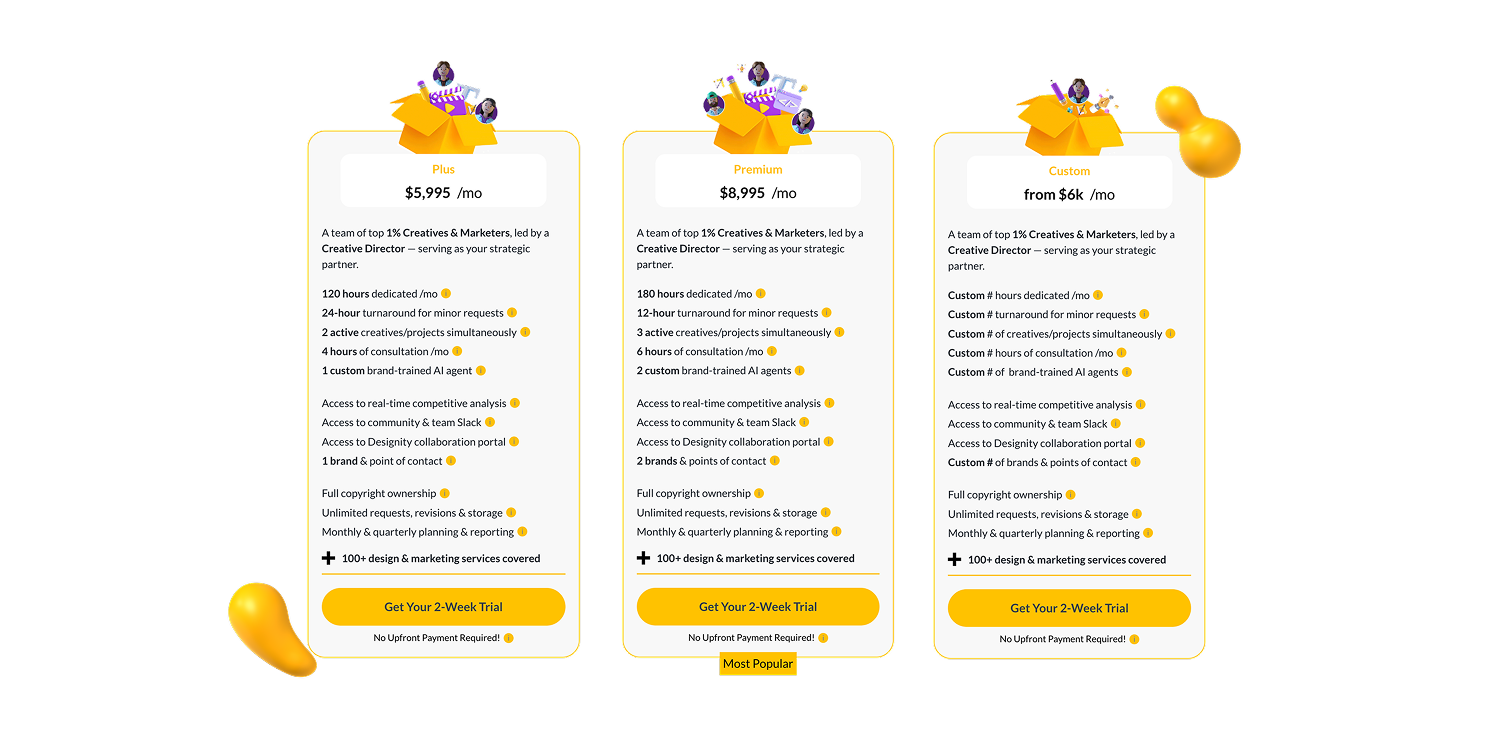
Designity uses this model, with plans starting at $5,995 per month and based on dedicated monthly hours, with flexible month-to-month terms rather than a long-term contract.
3. Credit-Based Pricing
Your subscription gives you a pool of credits or budget to use across different creative services. More complex projects use more of that allowance.
This can work well when your creative mix changes month to month, but you’ll want to know exactly how credits translate into deliverables.
Superside uses a variation of this model with its flexible monthly budget. Its subscriptions currently start at a $15,000 monthly minimum on an annual term, and its pricing also includes a $1,000 monthly software fee.
4. Project-Based Pricing
Have one campaign, rebrand, or major deliverable to tackle?
Some CaaS providers offer project-based engagements where you pay a fixed amount for a defined scope rather than ongoing monthly capacity.
It’s useful for one-offs, but less predictable if creative requests keep coming.
Pricing here varies significantly by scope, and many providers require a custom quote rather than publishing a standard project rate.
Superside, for example, offers paid, scoped Exploratory Projects in some cases, although it doesn’t publicly list a starting price for them.
5. Custom Enterprise Pricing
Large organizations may get a custom quote based on expected volume, services, team size, and creative capacity.
Superside, for example, requires an annual commitment for its subscriptions, while its Dedicated AI-Native Teams currently start at $30,000 per month on a 12-month term, plus a $1,000-per-month software fee.
What’s Usually Included in Creative-as-a-Service Pricing?
What’s included varies by provider, but most CaaS plans cover some combination of:
- Creative production: Design, ads, presentations, branding, video, web/UI, and content
- Requests and revisions: Often marketed as “unlimited,” though simultaneous output is usually capped
- Creative talent: A dedicated designer, creative pool, or multidisciplinary team
- Project management: Briefs, timelines, feedback, and resource coordination
- Creative direction and strategy: Senior oversight to guide quality, consistency, and execution
- Collaboration tools: Portals, asset management, communication, and AI-powered workflows
Now that you know how CaaS pricing works, what the different models look like, and what’s typically included, the bigger question is:
How does it compare to the traditional ways of getting creative work done?
CaaS vs. Agency vs. Freelancer vs. In-House: Cost Comparison
Here’s a closer look at how CaaS compares to agencies, freelancers, and in-house teams, and why more marketing leaders are considering it as an alternative:
What the Price Tag Doesn’t Tell You
Monthly cost is only part of the decision. Each model comes with tradeoffs, and costs that don’t always show up in the initial quote:
In-house:
- Pros: Deep brand knowledge, fast internal communication, full control
- Cons: Hard to scale quickly, limited skill coverage, hiring/turnover risk
- Hidden costs: Benefits/taxes/insurance can add 25–40% per salary, plus recruiting, onboarding, training, software, equipment, and management time
"I needed to find a third-party design firm to handle web banners and apparel design for my enterprise-size business. Designity has been a great resource. The cost is comparable to bringing in a dedicated in-house worker, but the contract-base relationship and the ability to swap out designers gives you more flexibility. Turnaround time and communication are good. I'd recommend Designity."
Agency:
- Pros: Broad expertise, strategy, outside perspective, scalable for major campaigns
- Cons: Longer onboarding, less brand familiarity, slower turnaround, often 3–12 month commitments
- Hidden costs: Setup fees of 500-5,000+, extra revision rounds around 150-500 each, rush fees of 20–50%+, reporting add-ons, software fees, and sometimes 5–20% of ad spend for media management
Freelancer:
- Pros: Flexible, specialized, cost-effective for focused needs
- Cons: Limited capacity, availability risk, harder to scale across disciplines
- Hidden costs: Sourcing, vetting, onboarding, project management, and coordinating multiple freelancers
CaaS:
- Pros: Predictable monthly spend, access to multiple specialties, easy to scale, faster turnaround, less vendor management, centralized workflows
- Cons: Quality varies by provider; may not replace highly specialized niche experts; not embedded in-house
- Hidden costs: Depending on the provider, watch for capacity limits, add-ons, unused hours/credits, annual commitments, and whether strategy or creative direction costs extra
So, what does a more strategic CaaS model look like in practice?
Designity’s Creative-as-a-Service Pricing: What You Get
Designity is a human-led, AI-enabled Creative-as-a-Service platform for mid-market to early enterprise marketing and creative teams that need more capacity without adding more hires, agencies, and freelancers to manage.
Instead of paying for production alone, you get dedicated monthly creative capacity backed by a Creative Director, project management, marketing strategy, top 1% creative and marketing talent, and access to 100+ services.
In other words, you’re not just adding more hands. You’re adding a managed creative team built to take ownership and scale with you.
Here’s a quick glimpse into Designity’s pricing plans:
So, what does that investment get you?
The ROI from Designity’s model goes beyond the number of hours in your plan:
- More efficient creative production: Designity estimates its Plus plan delivers a 52% lower cost per asset than traditional agency retainers ($55 vs. $115).
- Less work for your internal team: Consolidating creative production can save an estimated 4–8 hours per week on simpler deliverables. One Designity client freed up roughly 24 hours of internal design time per month.
- More room to scale: Dedicated capacity, 100+ creative and marketing services, and flexible plans let teams expand support without recruiting another specialist every time their needs change.
{{two-week-trial}}
Designity: Put Your Creative Budget in the Right Direction
Understanding Creative-as-a-Service pricing is only useful if it helps you get more value from your budget.
With Designity, that means more than production.
You get a dedicated Creative Director, top 1% global creatives and marketers, 100+ creative and marketing services, project management, strategy, and AI-enabled workflows with human oversight.
Plans start at $5,995/month, with flexible terms and a 2-week trial with no upfront payment.
Book a demo to see how your current creative workload could fit into a Designity plan.
4 FAQs Related to Creative-as-a-Service Pricing
Here are the answers to a few burning questions about CaaS pricing:
1. Is Creative-as-a-Service cheaper than an agency?
It can be, especially for ongoing creative needs.
CaaS plans can range from roughly $700 to $15,000+ per month, depending on the level of service, while traditional agency engagements often run 5,000- 50,000+ per month and may add fees for expanded scope, rush work, or extra revisions.
Designity’s AI-enabled, human-led CaaS platform, for example, starts at $5,995/month.
2. Is CaaS cheaper than hiring an in-house creative team?
Yes, often.
For example, a US graphic designer earns about $61,300 per year before benefits and overhead.
By comparison, Designity starts at $5,995/month, or $71,940 per year, for a Creative Director-led team with access to specialized creatives, marketers, project management, and strategy.
Instead of hiring each role separately, you get broader expertise within one managed team.
3. What is the difference between CaaS and an unlimited design subscription?
Unlimited design subscriptions can start around $700-1,000 per month and usually focus on production.
CaaS can add strategy, project management, specialist talent, and creative direction. Designity starts at $5,995/month for 120 dedicated hours.
4. How do I choose the right CaaS pricing model?
Start with what your team actually needs:
- Straightforward production: A lower-cost flat-rate subscription may be enough.
- Predictable monthly capacity: Look for plans based on dedicated hours or defined creative capacity.
- Strategy + execution: Choose a higher-touch CaaS model with creative direction, project management, and specialist talent.
- Complex or enterprise needs: Consider custom plans built around higher volume, multiple brands, or specialized support.









.png)