






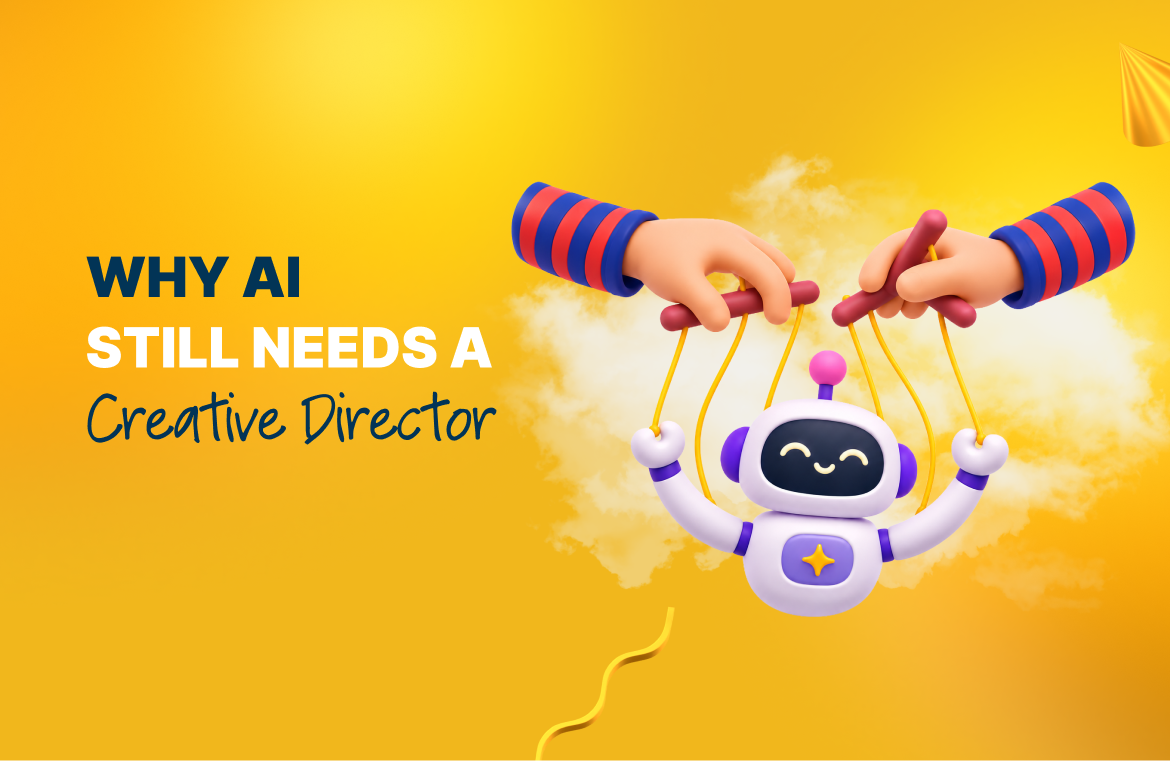
AI has changed what creative teams can do and how quickly they can do it.
The harder question is still the same.
Is this idea worth making?
As a Creative Director, I’ve found that the easier execution gets, the more human judgment matters.
Someone still has to spot the idea with potential, recognize what feels right for the brand, and know when a polished result needs another look.
In this guide, I’ll share how we use AI at Designity to research, develop ideas, produce visuals, and write copy, and where human taste shapes what actually makes it out the door.
Why I Bring a Creative Director’s Perspective to AI
I’m a Senior Creative Director at Designity with 10 years of experience.
My work spans advertising, branding, and illustration, with projects across financial services, healthcare, SaaS, and e-commerce.
I’ve worked across brand identity, digital campaigns, and video production, so I’ve had to make the same judgment call in very different formats.
What makes an idea feel like it could only come from this brand?
That’s the question I bring to AI-assisted work, too.
AI-Enabled Research Gives Creative Strategy More to Work With
One of the biggest ways AI has changed my own work as a Creative Director is also one of the least flashy.
It’s research.
Before deciding how a brand should look, sound, or position itself, I want to understand the business, its audience, and its competitors.
AI helps me get through that material faster.
I can compare how competitors position themselves, what they communicate, and what their work looks like.
I can see where everyone is following the same conventions and where a client’s brand might have room to stand out.
Spotting a pattern gives me something to investigate.
If every competitor in a category uses the same visual language, that could be an opportunity to break away.
It could also be a convention that helps customers recognize what they’re buying.
As Creative Director, I still have to decide which observations matter for this particular brand and which opportunity is worth pursuing.
Human-Led Creative Direction Sets the Quality Bar
It’s easy to see how people get the impression that AI production is a one-prompt job.
Type a few words into a box and, seconds later, there’s a charming animated portrait of your entire family.
You’d be forgiven for thinking a campaign could come together the same way. I wish it did.
AI video production is one of my favorite examples because the process still looks surprisingly familiar.
We start with strategy and an idea.
We develop concepts and scripts, build storyboards, and think through shots, characters, environments, and pacing.
Depending on the project, we’re still making decisions about casting, locations, wardrobe, and props.
Our actor might be a generated character, and our location might be a place we can try out without a physical scout.
Then there’s the craft of keeping it all coherent.
Lighting, styling, and composition have to feel like they belong in the same world.
A character has to look like the same person from one scene to the next.
Prompting is part of the job.
We might also generate elements separately, composite them, retouch them, correct the color, or edit them in conventional creative software.
There’s a lot of art direction between the first generation and the final cut.
Why a Solar Campaign Needed Less Solar in the Frame
The obvious temptation with generative AI is to ask for perfection.
Perfect people, perfect light, perfect everything.
One campaign led by Designity Lead Creative Director Pooyan Alizadeh made it particularly clear to me why a little imperfection can make the work feel more real.
The client was a solar company that wanted its panels to feel like part of everyday life.
The team deliberately kept details like skin imperfections and natural textures, while getting specific about the camera characteristics, lighting, and composition.
The most interesting decision was where to put the product.
“The hardest note I gave on this project was to make the product less visible. A solar company is paying you to show solar, and the direction was that nobody's eye should land there first. Panels on the edge of frame, half in shadow, just part of the house. AI will happily center the thing you mention most. Deciding what to pull back is a judgment call, and it's usually the one that makes the work feel real.”
— Pooyan Alizadeh, Lead Creative Director at Designity
The images felt realistic and consistent because the team knew what to pull back.
If the panels had been the first thing you saw in every shot, you’d have missed the everyday scene that made the idea work.
Faster AI Production Gives Us More Options to Evaluate
Until recently, if I needed a very specific person in a very specific place, doing something very specific, I had a couple of familiar options.
I could search for stock photography and compromise on the idea, or produce it from scratch.
Custom production opens up a lot of possibilities, with budgets, locations, casting, and logistics to match.
AI gives us another way to get a specific visual into a form we can evaluate.
We can explore an idea before committing to a physical shoot, or try a variation that would be expensive to set up on location.
Sometimes the idea still depends on a real person, product, place, or performance.cIn those cases, traditional production makes sense.
We can also get through more iterations while there’s still time to change direction.
But the ability to generate 100 options doesn’t mean you have 100 good options.
It means you have 100 decisions to make.
AI-Assisted Copywriting Still Needs Someone in the Driver’s Seat
I increasingly see brands using AI to write their own emails, web pages, and social posts.
And I get it.
It’s fast, it’s inexpensive, and nobody has to brief one more person.
The temptation is real.
You can usually tell when nobody was driving.
Without enough direction, AI tends toward predictable structures, generic language, and way too many words.
Good copy can be sharp, funny, or surprisingly simple because there’s an idea behind the line.
A copywriter can use AI to research, organize information, explore alternatives, or challenge a direction.
The writer brings the brand voice, audience context, and judgment to decide which line is actually worth reading.
Sometimes that judgment looks like cutting the sentence a tool spent three paragraphs teeing up.
What an AI-Enabled, Human-Led Creative Workflow Looks Like at Designity
In practice, a lot of the AI work happens behind the scenes.
We use AI to carry brand preferences and feedback forward, help turn rough requests into briefs the team reviews, and adapt approved creative across formats.
That gives the team a head start on the next project and can help cut avoidable revisions when the same feedback would otherwise have to be repeated.
A dedicated Creative Director leads creative direction and decisions.
A Creative Project Manager coordinates the work, and the creative team stays responsible for the ideas, brand fit, and quality.
When a project calls for generative assets, we agree on their use with the client and have people review the work.
Designity: Elevating Creative Excellence with AI and Human Expertise
AI has made creative execution faster and more accessible than ever.
But producing more ideas doesn't necessarily mean producing better work.
What sets great creative apart is the human judgment behind it: knowing which ideas deserve attention, what resonates with an audience, and how to turn creative possibilities into meaningful results.
As AI continues to evolve, human creativity, taste, and strategic thinking will only become more valuable.
Book a demo to unlock a 2-week trial and experience Designity’s AI-enabled, human-led Creative-as-a-Service platform on a real project.


