








.webp)

According to Adobe research, 71% of marketers expect the demand for content to grow fivefold or more by 2027.
But for financial services marketing teams, meeting that demand isn’t simply a matter of producing more content — it’s about doing so within strict regulatory boundaries.
As the pressure to deliver personalized, digital-first campaigns increases, 49% of financial firms say compliance slows down content production, according to Marketing LTB.
This creates a growing execution gap:
Marketing teams are expected to scale campaigns across more channels and move faster than ever, yet every asset must pass legal review and maintain brand trust.
To help close this gap, we’ll explore 10 next-gen financial services marketing strategies for 2026, and how teams can execute them without sacrificing compliance, creativity, or speed.
A Quick Introduction to Financial Services Marketing
At its core, financial services marketing is about promoting financial products and services to attract, engage, and retain customers across increasingly digital, competitive markets.
These offerings can range from everyday banking and insurance to more complex investment, lending, and wealth management solutions.
Unlike other industries, financial brands are often marketing services that are intangible, highly regulated, and directly tied to a customer’s long-term financial wellbeing.
Who Uses Financial Services Marketing?
A wide range of financial services companies and institutions rely on digital marketing to grow and retain their customer base, including:
- Commercial banks
- Credit unions
- Financial planning firms
- Insurance providers
- Investment banks
- Brokerage firms
- Accounting and tax advisory firms
What Are They Promoting?
Financial services marketers typically support offerings such as:
- Banking and loan products
- Wealth management services
- Insurance coverage
- Investment products
- Financial advisory services
- Accounting and tax consulting
Who Are They Trying to Reach?
Financial services are used by a diverse set of audiences, including:
- Individual consumers managing savings, credit, or retirement planning
- Commercial businesses seeking funding, asset management, or compliance support
- Financial Institutions such as healthcare providers or universities managing operational finances
Because these customers engage with financial products in different ways and at different stages of their financial journey, marketing strategies must be segmented, personalized, and multichannel to remain effective in a digital-first market.
10 Must-Know Financial Services Marketing Strategies and Trends
Stay ahead of shifting regulations, rising customer expectations, and digital disruption with these 10 must-know financial services marketing strategies and trends:
1. AI-Powered Personalization and Predictive Customer Experiences
What if you could anticipate when a customer is about to apply for a mortgage before they even start researching lenders?
AI-driven personalization helps financial brands move beyond one-size-fits-all campaigns by tailoring product recommendations to customer behavior, lifecycle stage, and financial goals.
For example, a retail bank might spot that a customer’s savings balance has steadily increased over six months and predict they’re preparing for a home purchase.
You can then trigger a personalized mortgage pre-qualification offer via email or in-app messaging at exactly the right moment.
2. Educational Content Marketing for Financial Decision-Making
In financial services, customers rarely convert after seeing one ad.
They research, compare options, and try to understand what they’re actually signing up for.
Educational content like blogs, retirement planning guides, mortgage checklists, product comparison pages, and in-depth whitepapers helps brands show up during that decision-making phase.
For example, an investment platform might publish a guide on “How to Build a Diversified Portfolio in Your 30s,” nurturing prospects with useful insights before introducing its managed portfolio offering.
3. Multichannel Marketing Across Email, SMS, Social, and Messaging Apps
Your customers aren’t just in their inbox. They’re in WhatsApp, on social media, and inside your app too.
Multichannel digital marketing helps financial brands deliver consistent lifecycle messaging across email, SMS, social platforms, messaging apps, and in-app notifications based on individual preferences.
But expanding across channels only works when your messaging and visual identity remain consistent across each customer touchpoint.
For example, Cardlytics, a financial advertising platform, partnered with Designity to create a series of social media and digital ad assets ahead of the Money 20/20 conference in Las Vegas.
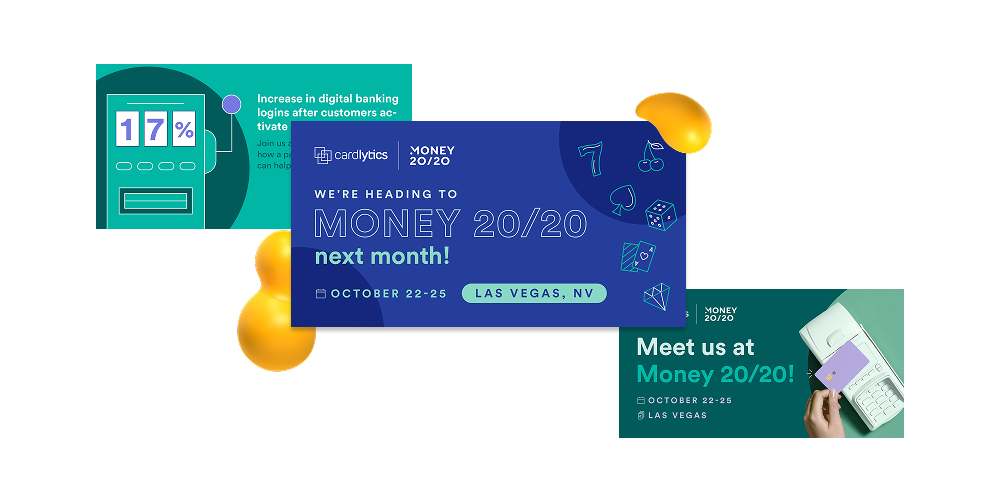
To support consistent marketing across channels, our team also developed detailed brand guidelines covering typography, color systems, illustration styles, and visual hierarchy.
These guidelines helped ensure Cardlytics’ campaign assets remained cohesive across social media, digital ads, and other digital marketing touchpoints.
4. Video and Interactive Content for Product Research
What does researching a mortgage or investment app look like in 2026?
For many customers, it means watching a 60-second walkthrough or using an interactive calculator before speaking to anyone.
Short-form videos, product explainers, onboarding demos, and tools like retirement planners or loan comparison widgets help simplify complex financial offerings and support self-directed research.
For example, Lighthouse Financial, a wealth management and retirement planning firm, worked with Designity to turn a static one-page sales document into an engaging motion graphic onboarding video.
Using voice-over, illustration, and scripted storytelling, the video simplifies investment goals, risk tolerance, and long-term strategy before prospective clients ever speak with an advisor.
5. Data-Driven Segmentation and Lifecycle Email Marketing
Around 72% of banking customers say personalization is highly important to their experience, according to Capco.
Data-driven segmentation allows financial brands to tailor lifecycle email campaigns based on customer behaviour, account activity, or financial milestones.
By timing outreach to events like onboarding, credit approval, or investment maturity, marketing teams can deliver more relevant messaging that improves engagement, retention, and long-term customer value.
6. User-Generated Content and Brand Relatability
When it comes to financial decisions, people trust people more than financial institutions.
User-generated content such as employee-led thought leadership, influencer partnerships, or behind-the-scenes onboarding content helps humanize financial brands.
Showcasing real experiences can make complex products feel more accessible while building credibility with audiences who may be skeptical of traditional financial advertising.
7. Account-Based Marketing for Institutional and B2B Clients
The average B2B tech purchase involves 6 to 10 decision-makers.
Account-based marketing (ABM) helps financial brands target key stakeholders such as CFOs, procurement teams, and finance directors with tailored messaging.
For example, an asset management firm might deliver personalized investment outlooks to executives while sharing operational efficiency content with finance teams evaluating treasury solutions.
8. Strategic Partnerships and Embedded Finance Opportunities
Some of the most effective financial marketing today happens outside traditional financial platforms.
Through partnership marketing and embedded finance integrations, brands can offer services within ecommerce platforms, travel booking apps, or SaaS tools.
For example, Acorns, a personal finance app that rounds up purchases and invests spare change, offers its Found Money feature through partner brands.
Users earn cashback into their investment accounts when spending with partners like Uber, Expedia, Apple, and ASOS.

9. Channel Diversification Beyond Traditional Search Platforms
Around 80% of Gen Z now spend time researching products on platforms like YouTube, 75% on Instagram, and 69% on TikTok.
As younger, mobile-first audiences reshape financial decision-making, discovery is moving beyond traditional search engines.
Financial brands are now distributing educational content, product explainers, and financial compliance-friendly guidance across social platforms to meet customers where they already research loans, investments, and insurance products.
For example, Wise, a global money transfer and multi-currency account platform, uses short-form, Gen Z–style TikTok videos to explain currency conversion through quick, interactive challenges.
This approach makes foreign exchange concepts more approachable and engaging for mobile-first audiences researching financial tools on social platforms.
10. Product-Led Campaigns That Adapt to Economic Shifts
Financial product demand often shifts alongside interest rates and inflation.
Product-led marketing campaigns allow brands to adjust messaging based on economic conditions.
For example, during periods of rising interest rates, a lender might promote fixed-rate loan products, while investment platforms could highlight capital preservation strategies in more volatile market environments.
5 Key Challenges in Financial Services Marketing
Financial services marketing comes with a unique set of challenges that can slow down execution, limit creativity, and impact campaign performance.
And while most marketing leaders understand these challenges at a strategic level, addressing them in practice is often more difficult.
Here are five of the most common barriers marketing teams face today:
1. Building Trust in a High-Risk Industry
Decisions are inherently risk-sensitive within the financial services industry.
Customers aren’t just buying a product, they’re trusting your institution with their savings, investments, or credit history.
Past market volatility and industry scandals have also made audiences more cautious, which means promotional messaging alone rarely builds confidence.
Marketing teams often need to rely on education, transparency, and demonstrated expertise to drive engagement.
2. Differentiating in a Saturated Market
Many financial products offer similar rates, terms, or features.
One mortgage or savings product may look nearly identical to another on paper.
At the same time, traditional institutions now compete with fintech apps, digital lenders, and investment platforms for attention.
Standing out often depends on how clearly you communicate value, not just what you’re offering.
3. Simplifying Complex Financial Products
Investment portfolios, insurance policies, and lending products can be difficult for customers to understand.
Marketing teams must translate technical details into accessible content without misrepresenting product terms or benefits.
Explaining these offerings in a way that builds understanding without overwhelming audiences requires both creativity and compliance awareness.
4. Navigating Regulatory and Data Privacy Requirements
Financial marketing campaigns must meet strict disclosure, consent, and privacy standards.
For example, targeted advertising using income or credit-related data may introduce fair lending concerns. AI-driven segmentation models can also create unintended bias if not monitored carefully.
Compliance teams often need to be involved throughout campaign development to reduce regulatory risk.
5. Overcoming Internal Execution Bottlenecks
Even when marketing strategies are in place, execution can be slowed by internal processes.
Campaigns may require approval from legal, compliance, and product teams before launch.
Customer data may also sit across separate CRM or analytics platforms, making segmentation harder than it should be.
The result?
Taken together, these challenges often create an execution gap between strategy and launch.
Marketing teams want to move quickly to test new messaging, while legal and compliance teams focus on accuracy and regulatory alignment. Leadership, meanwhile, expects measurable growth.
For example, launching a new personal loan campaign may require updating APR disclosures and eligibility terms across landing pages, emails, paid ads, and in-app messaging.
Before anything goes live, those assets typically need review from legal, compliance, and product teams.
While necessary, these approval stages can delay campaign deployment by days or even weeks.
Closing this gap between strategy and execution requires a different approach to campaign production.
{{drowning-in-projects-an}}
How Financial Brands Can Balance Speed, Compliance, and Creativity
To move faster without increasing regulatory risk, financial services firms are beginning to adopt compliant creative workflows that reshape how marketing campaigns are scoped, produced, and approved:
1. Build Compliance-By-Design into the Workflow
If compliance only enters the process at final review, delays are almost guaranteed.
Bring legal and compliance teams into campaign planning early to align on messaging, targeting, and required disclosures before production begins.
This reduces revision cycles later and makes it easier to launch campaigns tied to lending terms, insurance policies, or investment products without rewriting assets across multiple regulated financial marketing channels.
2. Create Pre-Approved Messaging and Design Libraries
Financial services companies often reuse similar product language across landing pages, emails, ads, and onboarding flows.
Creating pre-approved messaging for lending terms, insurance coverage, or investment features allows marketing teams to move faster.
Reusable disclosure templates and UX-ready design components help ensure required risk statements can be implemented consistently across digital touchpoints without triggering fresh compliance reviews for every update.
3. Use Tiered Approval Workflows
Not every asset needs the same level of legal scrutiny.
A financial literacy blog post doesn’t carry the same regulatory risk as a performance-based investment ad or mortgage rate promotion.
Segmenting approval workflows by content type allows low-risk educational content to launch quickly while higher-risk product messaging still receives full compliance review.
This improves time to market without increasing legal or reputational exposure.
4. Lead with Educational Content Where Possible
Educational content often faces fewer regulatory hurdles than product promotion.
Retirement planning guides, loan explainers, or budgeting tools help build trust without making performance claims.
This supports E-E-A-T by demonstrating expertise and transparency while helping customers understand complex offerings before entering application or onboarding journeys.
5. Design Creative with Transparency In Mind
Financial regulations require that both benefits and risks are presented fairly.
Instead of adding disclosures at the last minute, integrate them into campaign design from the start using plain-language explanations or consistent visual formats.
Focusing customer stories on decision-making processes rather than outcomes can also improve engagement while staying within testimonial and advertising guidelines.
6. Use Technology to Streamline Approvals
Modern compliance and marketing platforms can automatically route assets through legal or product reviewers.
These tools help flag unsupported claims, track disclosure updates, and maintain version history for audit purposes.
Reducing manual review steps makes it easier to deploy rate updates, promotional offers, or onboarding campaigns quickly while maintaining documentation required for regulatory oversight.
7. Use Scalable Creative Support to Accelerate Execution
In financial services, updating product rates or eligibility criteria often requires revising landing pages, lifecycle emails, paid ads, and in-app messaging at the same time.
In-house teams may not have the bandwidth to manage these updates quickly, while traditional agencies can introduce longer onboarding or revision cycles.
On-demand design and marketing support models such as Designity’s Creative-as-a-Service (CaaS) provide dedicated production capacity to implement compliant updates faster, enabling quicker campaign launches and consistent disclosures across lifecycle touchpoints.
Designity: Compounding Creative Returns for Financial Marketers
Scalable creative support enables financial services marketing teams to execute campaigns faster without compromising brand integrity or regulatory compliance.
Across banking, fintech, wealth management, and insurance, staying competitive means launching omnichannel campaigns quickly while maintaining consistency in highly regulated environments.
That level of execution requires experienced creative leadership and flexible production capacity.
Designity supports financial marketing teams with:
- A dedicated Creative Director with 10+ years of experience, matched to your specific financial services niche
- An on-demand team from the top 1% of vetted creative and marketing talent experienced in regulated industries
- A centralized platform for managing requests, revisions, approvals, and timelines
- Predictable monthly pricing for improved marketing budget control
- Access to 100+ creative and marketing services under one subscription
Trusted by financial services organizations including Mastercard, Atlanticus, Cryptocurrency Wallet, Personiv, and more, Designity helps marketing teams launch compliant, high-impact campaigns faster while maintaining consistent brand storytelling across channels.
The result is faster go-to-market timelines for compliant campaigns, improved marketing ROI, and the flexibility to scale creative execution as business priorities and regulatory requirements evolve.
Book a demo to see how Designity can support your financial services marketing team.